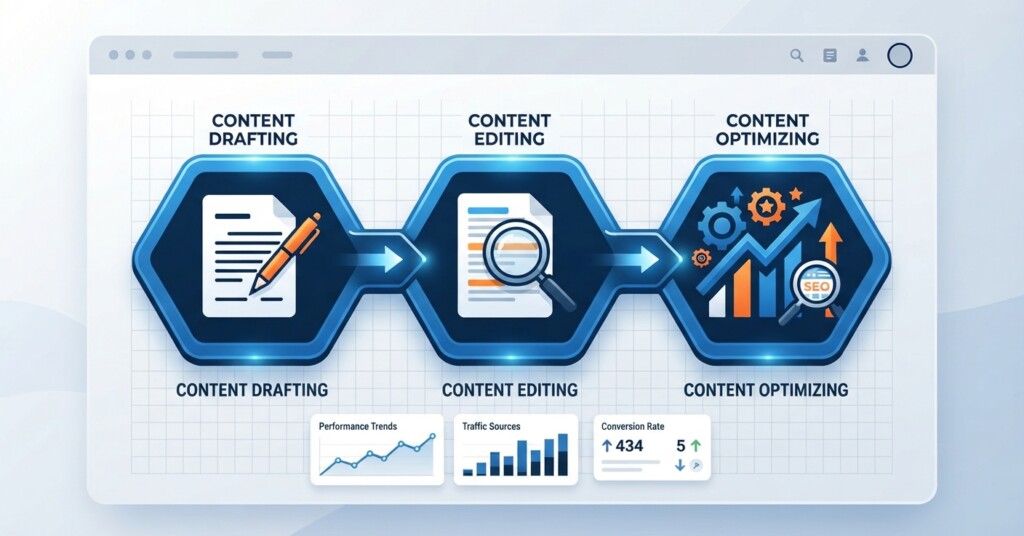
AI writing tools have made it faster than ever to produce blog content, but speed without structure creates a new problem: thin, generic posts that search engines quietly bury and readers quickly abandon. A solid AI content creation workflow solves this by treating AI as one part of a larger process, not a replacement for editorial judgment. In this article, you will learn how to build a repeatable workflow for drafting, editing, and optimizing blog posts with AI so you keep the speed benefits without sacrificing quality, originality, or search rankings.
Why Most AI-Generated Blog Posts Underperform
When a marketing team plugs a keyword into an AI tool and publishes whatever comes out, the result tends to read like everyone else’s content because it is built from the same training data and the same patterns. Search engines have gotten better at identifying unoriginal and low-value content, and even when generic posts slip through automated quality systems, readers notice the lack of specificity, real examples, and a genuine point of view. The fix is not avoiding AI. It is separating the writing process into distinct stages, each with a clear purpose, so AI handles the heavy lifting on structure and speed while humans handle judgment, accuracy, and voice.

Stage One: Drafting With AI Without Losing Your Voice
The drafting stage is where AI tools genuinely shine, but only if you feed them the right inputs. A vague prompt like ‘write a blog post about email marketing’ produces a vague post. Instead, treat the AI like a new team member who needs a thorough brief: your target reader, the specific angle you want to take, examples or data points to include, and the tone you’re going for. The more context you provide, the less generic the output will be, which means less rewriting later.
- Write a one-paragraph brief that defines the reader, their problem, and the outcome the post should deliver.
- Ask the AI tool to generate an outline first, not a full draft, so you can adjust structure before any prose is written.
- Feed the AI real examples, quotes, or data from your own experience to anchor the draft in something specific.
- Generate the first draft section by section rather than all at once, reviewing each part before moving forward.
- Rewrite the introduction and conclusion yourself, since these sections carry the most voice and are what readers judge first.
Treat the AI draft as raw material, not a finished product. A useful mental model: the AI gets you to 60 percent done. The remaining 40 percent — accuracy checks, examples, and voice — is where the content actually earns trust and rankings.
Stage Two: Editing for Accuracy, Depth, and Originality
Editing AI-drafted content is different from editing human-written drafts because the errors are different. AI models can state incorrect facts with total confidence, a problem often called ‘hallucination.’ They can also produce content that sounds authoritative while saying very little, stringing together plausible sentences that never quite commit to a specific claim. Your editing pass needs to hunt for both problems specifically, not just check grammar and flow.

Start by fact-checking every statistic, claim, or named source the AI included, since these are the most common source of errors. Next, scan for vague statements that sound smart but say nothing — phrases like ‘businesses should leverage data to drive growth’ need to be replaced with something concrete, such as a specific metric, tool, or process. Finally, read the piece aloud. If it sounds like it could have been written about any company in any industry, it needs another pass to add details only you or your brand would know: a client story, an internal process, a number from your own results.
Stage Three: Optimizing Blog Posts for Search Without Overdoing It
Optimization is the stage where AI content creation workflows most often go wrong, because teams treat SEO as a checklist to satisfy rather than a way to match reader intent. Keyword placement still matters, but modern search algorithms weigh relevance, depth, and user satisfaction signals far more heavily than exact keyword density. The goal at this stage is to confirm the post actually answers the question a searcher typed in, structures information so it’s easy to scan, and includes the kind of specific, experience-based detail that generic AI content lacks.
| Optimization Check | What to Look For | Why It Matters |
|---|---|---|
| Search intent match | Does the post directly answer the query, or does it circle around the topic? | Search engines prioritize content that satisfies the searcher’s actual goal, not just keyword matches. |
| Heading structure | Are H2s and H3s scannable and descriptive, not just decorative? | Clear structure helps both readers and search crawlers understand content hierarchy. |
| Originality signals | Are there examples, data, or opinions not found in competing posts? | Unique value is what separates ranking content from content search engines see as redundant. |
| Internal linking | Does the post link to related articles on your site? | Internal links help search engines understand topic relationships and keep readers engaged longer. |
| Readability | Are sentences and paragraphs short enough to scan on mobile? | Most organic traffic arrives on mobile devices, and dense text increases bounce rates. |
Do not publish AI-drafted content without a human review pass, even if it reads smoothly. Smooth prose can still contain factual errors, outdated information, or claims your legal or compliance team would flag. A single inaccurate statistic can undermine trust in an otherwise strong post and create real risk if it involves pricing, health, or financial claims.
Building a Repeatable Workflow Across Your Team
A workflow only pays off if it’s repeatable, which means writing it down and assigning clear ownership at each stage. Consider a small business owner who writes one blog post a week. Without structure, she might spend three hours generating a draft and rewriting most of it from scratch out of frustration. With a defined workflow, she spends thirty minutes briefing the AI tool with specifics about her business, twenty minutes reviewing the outline, sixty minutes editing for accuracy and voice, and thirty minutes on the optimization checklist. The total time drops, but more importantly, the output becomes consistent post after post because the process, not her mood or energy level that day, drives the quality.
For larger marketing teams, this often means assigning a content strategist to own the briefing stage, a subject matter expert to review accuracy, and an SEO specialist to run the optimization checklist before publishing. Splitting these responsibilities prevents any single stage from being rushed, which is usually where quality breaks down. It also creates a paper trail — briefs, edit notes, optimization checklists — that makes it easier to train new team members and maintain consistency as the team scales.
Key Takeaways
- Separate AI content creation into distinct drafting, editing, and optimizing stages, each with a specific goal.
- Feed AI tools detailed briefs with real examples and audience context to reduce generic output before it starts.
- Edit specifically for factual accuracy and vague, unspecific claims, not just grammar and tone.
- Optimize for search intent and originality first, keyword placement second.
- Document the workflow so it produces consistent results regardless of who runs it.
Getting AI content creation workflows right is less about finding the perfect tool and more about building a process that catches what AI tends to miss: accuracy, specificity, and a genuine point of view. Teams that draft with clear briefs, edit deliberately for depth and truth, and optimize with search intent in mind consistently produce blog posts that hold up in rankings and earn reader trust, even as more of the writing process becomes AI-assisted.
Want to go deeper on content strategy?
Explore more practical guides on content marketing, SEO, and workflow frameworks built for marketers who need to move fast without cutting corners.