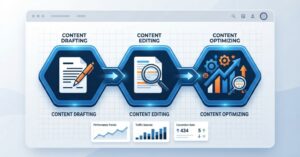
Writing ad copy used to mean staring at a blank document, testing five headlines by gut feel, and hoping one of them worked. AI-powered ad copywriting changes that equation. With the right prompts and a repeatable workflow, you can generate dozens of tested headline and description variations for Google and Meta ads in minutes instead of hours, then use data to pick winners instead of guessing. This article walks through exactly how to structure prompts, build a review workflow, and avoid the generic-sounding output that makes so much AI copy fall flat.
By the end, you will have a practical system for using AI tools like ChatGPT, Claude, or Gemini to produce ad copy that reflects your brand voice, meets platform character limits, and is genuinely built for conversion rather than just speed.
Why AI-Powered Ad Copywriting Works (When Done Right)
AI language models are pattern-matching machines. Give them thousands of examples of persuasive copy structures, benefit-driven language, and calls to action, and they can produce plausible ad variations almost instantly. The advantage is not that AI is more creative than a skilled human copywriter. It is that AI removes the friction of volume. Instead of writing three headlines, you can generate thirty, then use human judgment and performance data to select the strongest ones.
The catch is that AI defaults to safe, generic phrasing unless you feed it specific, detailed prompts. Vague inputs like write me a Google ad for my shoe store produce vague outputs. The quality of your ad copy is directly tied to the quality of the context you provide. This is where a structured workflow makes the difference between copy that sounds like everyone else and copy that actually converts.

Building Prompts That Generate Converting Copy
A strong prompt for ad copywriting includes five elements: the product or service, the target audience, the key benefit or offer, the tone or brand voice, and the platform constraints. Skipping any one of these leads to copy that needs heavy editing. Think of your prompt as a creative brief you would hand to a junior copywriter, not a one-line request.
Here is a prompt template you can adapt for Google Search ads: Write 10 headline options (max 30 characters each) and 4 description options (max 90 characters each) for a Google Search ad promoting [product/service]. The target audience is [specific customer description, including pain point]. The main offer or differentiator is [offer]. The tone should be [tone, e.g., confident and direct, warm and reassuring]. Avoid generic phrases like best in class or #1 choice. Include at least 3 headlines that lead with a number, price, or specific outcome.
For Meta ads, adjust the prompt to account for the more conversational, scroll-stopping nature of feed placements: Write 8 primary text options (under 125 characters for the visible portion) and 5 headline options for a Meta ad targeting [audience]. The ad should feel like it is speaking directly to someone scrolling their feed, not like a traditional advertisement. Reference the specific problem of [pain point] in the first line. Include a mix of question-based hooks, statement-based hooks, and social proof-based hooks.
Always specify character limits and format constraints directly in the prompt. AI models frequently ignore length rules unless you state them explicitly and remind the model of the limit again in the same message.
A Practical Workflow: From Prompt to Published Ad
Generating copy is only step one. A repeatable workflow ensures the copy you publish is actually likely to convert, not just plausible-sounding. Use this five-step process for any new campaign.
- Research first: Before prompting, gather 3 to 5 real customer reviews, support tickets, or survey responses that describe the problem in the customer’s own words. Feed these directly into your prompt as reference material.
- Generate in bulk: Ask for at least 15 to 20 headline variations and 6 to 8 description or primary text variations per ad group, so you have real variety to choose from.
- Edit for brand voice: Rewrite AI output in your own words where it sounds robotic or overly formal. Read every line out loud; if it sounds like a corporate press release, revise it.
- Map to funnel stage: Sort variations into top-of-funnel (awareness, curiosity-driven), middle-of-funnel (comparison, benefit-driven), and bottom-of-funnel (offer, urgency-driven) so each ad group has a clear intent match.
- Test in small batches: Launch 3 to 4 variations per ad group rather than all 20 at once, so you get statistically meaningful data faster and can iterate based on real click-through and conversion rates.
This workflow keeps AI in its proper role: a first-draft generator and idea multiplier, not a final decision-maker. The human review and editing step is not optional. It is what separates ads that convert from ads that simply exist.
Real-World Example: A Local Service Business
Consider a mid-sized HVAC company running Google Search ads for emergency repair services. A generic prompt produces headlines like Reliable HVAC Repair or Trusted Heating Experts, both of which are indistinguishable from every competitor’s ad. Instead, the marketing manager fed the AI actual customer feedback: reviews mentioning same-day appointments, technicians who explained pricing upfront, and relief at not being overcharged during a heat wave.
The revised prompt included this context and asked specifically for headlines referencing speed, transparency, and local trust signals. The output included lines like Same-Day AC Repair Today, No Overcharge Guarantee, and Fixed Fast, Fair Price, all of which tested significantly higher in click-through rate than the generic originals because they mirrored language real customers already used to describe their pain points and desired outcomes.
For a Meta ad campaign promoting a subscription meal kit, the same principle applied. Instead of generic copy about healthy eating, the team prompted the AI using customer language about being too tired to meal plan after work. The resulting primary text options that led with a relatable statement, such as admitting the 6pm question of what’s for dinner is exhausting, consistently outperformed benefit-list style copy in both click-through rate and cost per result.
| Ad Element | Generic AI Output | Context-Rich AI Output |
|---|---|---|
| Array | Array | Array |
| Array | Array | Array |
| Array | Array | Array |
| Array | Array | Array |
Never publish AI-generated ad copy without a human fact-check pass. AI models can invent statistics, misstate pricing, or reference guarantees and claims your business does not actually offer. Running unverified claims in paid ads can create legal exposure and damage customer trust.
Using AI for Testing, Not Just Writing
One underused application of AI-powered ad copywriting is analyzing performance data to inform the next round of prompts. After a campaign has run for one to two weeks, export your top and bottom performing headlines by click-through rate and conversion rate. Feed both lists back into the AI tool and ask it to identify patterns: sentence length, use of numbers, question versus statement format, emotional tone.
This turns AI into a lightweight analysis partner as well as a drafting tool. A prompt like this works well: Here are my top 5 performing headlines and bottom 5 performing headlines from the last two weeks, along with their click-through rates. Identify patterns in structure, tone, and length that separate the top performers from the bottom performers, then generate 10 new headlines that apply those patterns.
Over several campaign cycles, this feedback loop compounds. Your prompts get sharper because you are feeding the AI real performance signals instead of just assumptions about what might work. This is genuinely one of the more powerful uses of AI in marketing, since it merges creative generation with a data-informed strategy framework rather than treating them as separate tasks.

Key Takeaways
- AI-powered ad copywriting works best as a volume and speed tool, not a replacement for human judgment and brand voice editing.
- Detailed prompts that include audience, offer, tone, and platform constraints produce far better output than generic one-line requests.
- Feed AI real customer language from reviews and support tickets to avoid generic, forgettable copy.
- Use a five-step workflow: research, generate in bulk, edit for voice, map to funnel stage, and test in small batches.
- Always fact-check AI-generated claims before publishing, since models can invent statistics or guarantees that do not exist.
- Close the loop by feeding performance data back into AI prompts to refine future copy generation.
AI-powered ad copywriting is not about outsourcing your strategy to a chatbot. It is about using a genuinely useful tool to remove the bottleneck of writing dozens of variations by hand, so you can spend more time on the parts of the job that actually require human insight: understanding your customer, interpreting performance data, and making the final call on what represents your brand well. Practitioners who treat AI as a first-draft partner, backed by a disciplined workflow, consistently produce higher-converting Google and Meta ads than those who either avoid AI entirely or rely on it uncritically.
Ready to sharpen your paid advertising skills further?
Explore more practical, step-by-step guides on paid advertising, analytics, and AI in marketing to keep building a digital marketing skill set you can apply immediately.