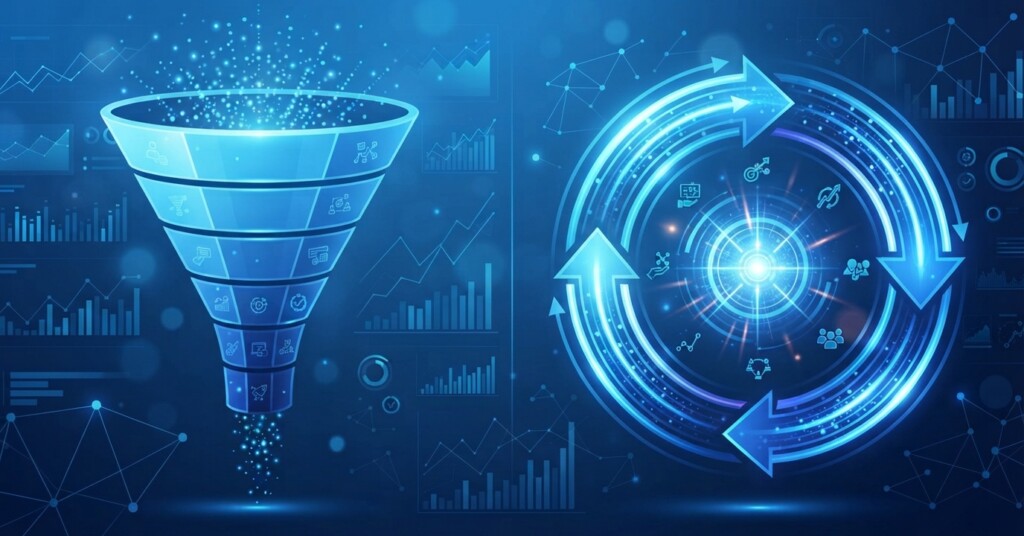
Most marketers were trained to think in funnels: attract a stranger, nurture them through awareness and consideration, then convert them into a customer. It is a clean, linear model that has shaped marketing strategy for decades. But a growing number of high-growth companies have quietly shifted to a different mental model entirely — growth loops. Instead of a straight line that ends at conversion, a growth loop is a closed system where the output of one cycle becomes the input for the next, creating acquisition that compounds rather than resets. Understanding growth loops versus marketing funnels is not an academic exercise; it changes how you allocate budget, design products, and measure success.
What a Marketing Funnel Actually Does (and Where It Breaks Down)
A marketing funnel describes the journey a prospect takes from first contact to purchase, typically broken into stages such as awareness, interest, consideration, intent, and conversion. The model is useful because it forces you to think about what message and channel fits each stage of buyer readiness. A cold visitor from a display ad needs different content than someone comparing pricing pages.
The funnel’s weakness is structural, not conceptual. Every person who converts simply exits the system. To get the next customer, you have to refill the top of the funnel again, usually by spending more on ads or content distribution. Growth becomes a function of how much you can spend on acquisition, and it flattens the moment budget flattens. This is why so many companies hit a plateau: they built a machine that produces customers, but the machine does not feed itself.
Funnels also tend to treat the customer relationship as finished at the sale. Retention, referral, and reactivation are often bolted on as separate programs rather than engineered into the core acquisition model from day one.
What a Growth Loop Is, in Plain Language
A growth loop is a repeatable cycle where an action taken by a user generates an output that attracts or activates new users, who then repeat the same action. Instead of acquisition, activation, and retention sitting in separate buckets, they are stitched into one loop that regenerates its own fuel.
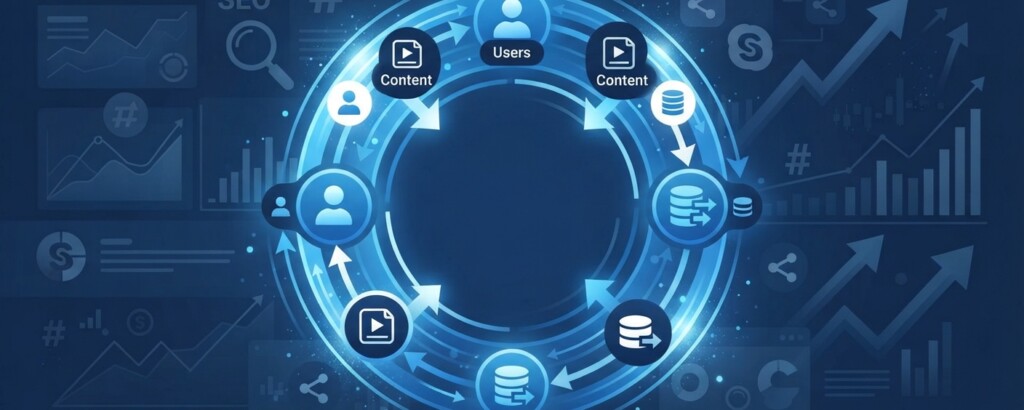
Think of it in four basic steps common to most loops: a user receives value, that value creates an output (content, data, an invite, a review), the output reaches new people, and a portion of those new people become users who repeat the cycle. The loop keeps turning without requiring a fresh injection of paid spend every time.
Dropbox’s referral program is the textbook example. A user gets more storage by inviting friends. The invite is the output. New users sign up, get storage by inviting their own friends, and the loop turns again. Pinterest works similarly through SEO: users pin content, that content gets indexed and ranks on Google, search traffic brings in new users, who pin more content. Each case shares the same property — growth is a byproduct of product usage, not a separate campaign running parallel to the product.

The simplest test for whether a product- or content-driven growth loop is working: ask what happens if you pause top-of-funnel media spend for three months. A linear paid funnel goes quiet almost immediately. A healthy organic loop keeps generating new users because the acquisition mechanism is embedded directly in product or content usage rather than an ongoing ad budget.
Funnels and Loops Are Not Enemies — They Solve Different Problems
It is tempting to declare loops superior and funnels obsolete, but that is not how mature marketing organizations operate. Funnels are still the right tool for controlled, predictable demand generation, especially for high-consideration purchases like enterprise software or financial services, where a referral loop alone cannot carry the weight of a six-figure deal. Loops excel at consumer products, marketplaces, and content platforms where the core action is inherently shareable or network-driven.
In practice, the strongest growth strategies layer both. A funnel might be responsible for converting a cold prospect into a first-time user, while a loop takes over from there — turning that user into a source of new leads through referrals, user-generated content, or SEO-indexed output. The funnel handles the first mile; the loop handles the compounding miles after it.
| Dimension | Marketing Funnel | Growth Loop |
|---|---|---|
| Shape | Linear, ends at conversion | Circular, output feeds back as input |
| Growth driver | Ad spend and content distribution | Product usage and network effects |
| Scaling behavior | Requires proportional budget increase | Can compound without proportional spend |
| Best fit | High-consideration B2B, new category education | Consumer apps, marketplaces, content platforms |
| Primary risk | Diminishing returns on paid channels | Loop decay if incentive or value weakens |
| Measurement focus | Cost per acquisition, conversion rate by stage | Loop cycle time, viral coefficient, retention rate |
How to Actually Design a Growth Loop
Building a loop is less about creativity and more about mapping mechanics honestly. Start by identifying the core action your most engaged users already take. Do they share results, publish content, invite teammates, or generate data that others find useful? The loop should amplify something that is already happening naturally rather than invent an artificial incentive from scratch.
- Map the current user journey and identify any point where a user’s action already creates visible output for someone else (a review, a shared document, a public profile, a piece of content).
- Define the output clearly — is it content that search engines can index, a message that reaches the user’s network, or data that improves the product for others?
- Design the bridge that connects the output back to new user acquisition, such as a watermark, a shareable link, or an SEO-optimized page generated from user activity.
- Reduce friction at the reentry point so new users who arrive via the output can quickly experience the same core value that started the loop.
- Instrument the loop with metrics for each stage so you can see exactly where it is strong and where it leaks.
The metrics that matter for loops differ from funnel metrics. Instead of cost per lead, you track loop cycle time (how long it takes for one full rotation), the conversion rate at each handoff point, and the viral coefficient or amplification factor — how many new users each existing user’s action generates. While a viral coefficient consistently above one creates exponential, self-sustaining growth, sustained rates above one are rare; even below one, a functioning loop compounds and multiplies acquisition rather than resetting like a linear funnel.
Do not force a loop where the product does not naturally support one. Bolting a referral widget onto a product with low engagement or low shareability usually produces a weak loop that decays fast and wastes engineering time. Validate that users already want to share or publish before building the mechanism around it.
Common Mistakes When Shifting From Funnel Thinking to Loop Thinking
The most frequent mistake is treating a loop like a one-time feature launch rather than an ongoing system that needs maintenance. Loops decay. Referral incentives lose novelty, SEO algorithms change, and social platforms adjust what content gets distributed for free. A loop that worked brilliantly two years ago can quietly stop turning if nobody is monitoring its cycle time and conversion rates the way a paid campaign manager watches cost per click.
A second mistake is measuring loops using funnel-era KPIs. If you judge a referral program purely on short-term conversion rate without tracking how it compounds over six or twelve months, you will underestimate its value and potentially kill a mechanism that was just starting to gain momentum. Loops often look unimpressive in week one and extraordinary by month six, because compounding takes time to become visible.
Finally, many teams forget that loops require cross-functional ownership. A referral loop touches product design, engineering, lifecycle email, and brand — not just the acquisition marketing team. Funnels can live almost entirely within a paid media or content team’s control. Loops cannot, and organizations that keep loop design siloed inside marketing usually end up with a weak, half-built version of the mechanism.
Key Takeaways
- Funnels are linear and require continuous spend to refill the top; growth loops are circular and reinvest their own output to generate new users.
- Loops work best when they amplify an action users are already taking, such as sharing, publishing, or inviting collaborators.
- Track loop-specific metrics — cycle time, amplification factor, and conversion at each handoff — rather than applying funnel KPIs like cost per lead.
- The strongest acquisition strategies combine both: a funnel to convert initial demand, and a loop to compound growth from existing users.
- Loops decay over time and need cross-functional ownership, not a one-time launch mentality.
Growth loops versus marketing funnels is ultimately a question of where you want growth to come from: a budget you control or a mechanism the product and your users sustain on their own. Neither model replaces the other entirely, but if your acquisition cost keeps climbing while growth stays flat, that is usually a sign you are relying on a funnel to do a loop’s job. Mapping even one loop into your current strategy can change the trajectory of how your acquisition scales over the next year.
Want to build your own growth loop?
Explore more practical frameworks on marketing strategy, analytics, and customer acquisition to start designing systems that grow on their own.