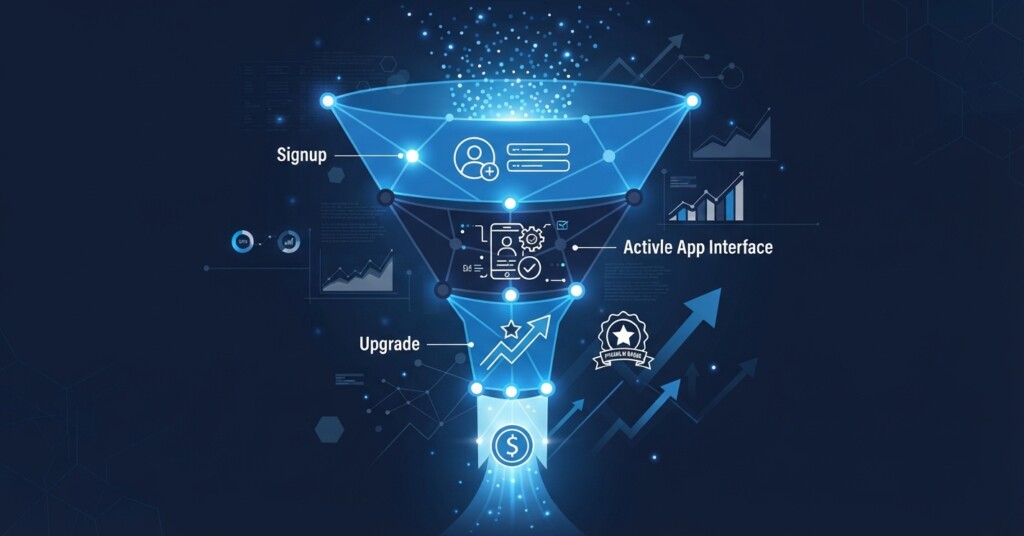
If you have ever signed up for a tool, used it for a few days, and then upgraded without ever talking to a salesperson, you have experienced product-led growth firsthand. This article walks through a practical product-led growth playbook for turning free users into paying customers without a sales team — the exact mechanics marketers and product teams use to let the product itself do the selling. By the end, you will understand how to design free-to-paid funnels, which data points actually predict conversion, and how to avoid the mistakes that quietly kill upgrade rates.
What Is Product-Led Growth, and Why Does It Matter for Digital Marketers?
Product-led growth, often shortened to PLG, is a go-to-market strategy where the product itself drives acquisition, conversion, and expansion — rather than a sales team cold-calling prospects or closing deals in demos. Users try the product for free (through a free trial or a freemium plan), get real value from it, and then choose to pay for more features, more usage, or more seats. Think Slack, Dropbox, Canva, Calendly, and Zoom. None of these companies built their early growth on outbound sales teams. They built it on products good enough to spread on their own, paired with smart in-product and lifecycle marketing. For marketers, this shifts the job. Instead of generating leads for a sales rep to chase, you are responsible for guiding a self-serve user from signup to aha moment to upgrade. That means your toolkit expands beyond ads and landing pages into onboarding emails, in-app messaging, usage-based triggers, and conversion-focused copywriting placed directly inside the product experience.
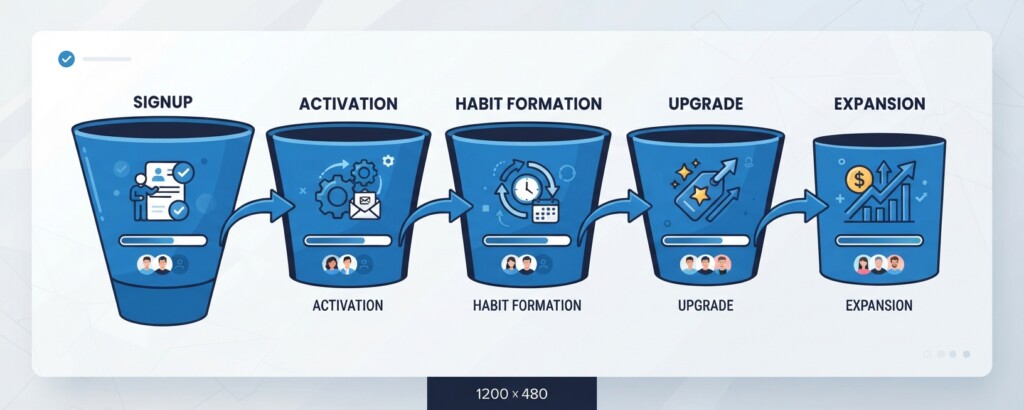
The Product-Led Growth Playbook: Turning Free Users into Paying Customers Step by Step
A strong PLG motion is not luck — it is a sequence of deliberate decisions. Here is the core playbook most successful self-serve companies follow, in order.
- Define your activation moment — the specific action that correlates with a user understanding your product’s value (for example, a team exchanging 2,000 messages in Slack or a user creating a first design in Canva).
- Shorten time-to-value by removing setup friction; cut unnecessary form fields, pre-fill templates, and use smart defaults so users reach the activation moment fast.
- Set usage limits or feature gates that are generous enough to build habit but tight enough to create natural upgrade pressure once the user is engaged.
- Build a lifecycle email sequence triggered by behavior, not just time — a user who hits a limit should get a different message than one who has not logged in for a week.
- Add contextual in-app prompts at the exact moment a user bumps into a limitation, with a clear, benefit-driven call to action.
- Track activation and conversion metrics weekly, and run small experiments on pricing page copy, trial length, and upgrade prompts.
- Layer in a low-touch ‘assisted sales’ option for high-intent accounts, such as a chat widget or a book-a-call link, without building a full outbound team.
Tip: Spend real time nailing down your activation moment before building anything else. If you do not know which action predicts long-term retention, every email and in-app prompt you build afterward is a guess. Pull a cohort of your most retained users and look for the behavior they all share in their first week.
Designing the Free-to-Paid Funnel: Key Levers You Control
Most PLG companies choose between three common models for letting users experience the product before paying. Each has different implications for marketing, onboarding, and conversion timing.
| Model | How It Works | Best For | Main Risk |
|---|---|---|---|
| Freemium | Users get permanent free access to a limited feature set or usage cap | Products with strong network effects or habitual daily use | Users stay on free tier forever and never feel pressure to upgrade |
| Free Trial | Full access for a fixed period (commonly 14 or 30 days), then paywall | Products where value takes time to demonstrate, like analytics tools | Users churn before reaching their activation moment |
| Reverse Trial | Users start with full premium access, then get downgraded to a free tier | Products with clear ‘wow’ features that are easy to miss on a basic plan | Users feel a sense of loss, which can hurt brand perception if handled poorly |
The model you choose shapes everything downstream. A freemium model means your email and in-app strategy needs to continually resurface the case for upgrading, since there is no deadline forcing a decision. A free trial model puts urgency to work for you, but only if users reach value fast enough to justify payment before time runs out. A reverse trial borrows urgency from loss aversion — people feel downgrades more sharply than they feel missed upgrades, which can be a powerful, if slightly riskier, conversion lever.
Using Data and Analytics to Spot Conversion Opportunities
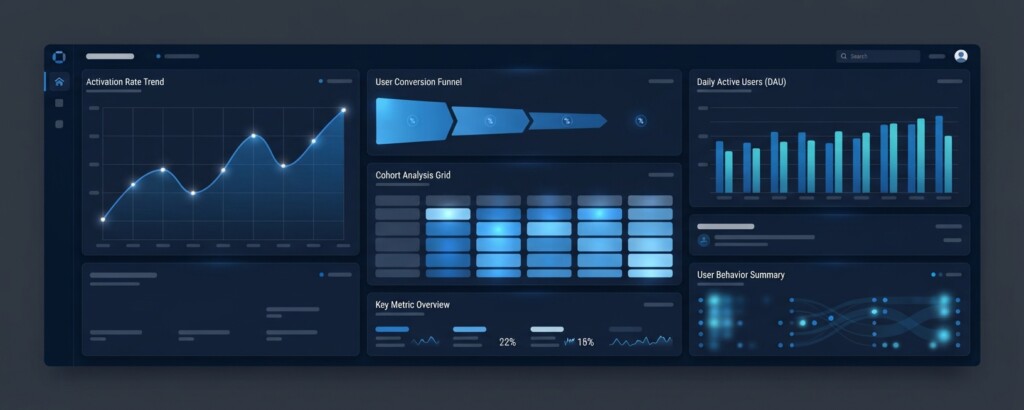
Product-led growth lives or dies on data. Unlike traditional sales-led funnels where a rep can read buying signals in a conversation, self-serve conversion depends on behavioral signals captured through analytics. There are four metrics worth tracking closely: activation rate (percentage of signups who complete your defined activation action), time-to-value (how long it takes a new user to reach that action), feature adoption (which features correlate with upgrades), and trial-to-paid conversion rate segmented by acquisition channel. Cohort analysis is especially useful here. Group users by signup week and track what percentage convert over the following 30, 60, and 90 days. If conversion rates are improving for newer cohorts, your onboarding changes are working. If they are flat or declining, something upstream — targeting, messaging, or onboarding friction — needs attention. Event-based tools that track in-product behavior (not just pageviews) are essential, since the signals that matter most happen inside the product, not on your marketing site.
Common pitfall: Many teams gate too many features too early, or bombard free users with upgrade emails before they have experienced any real value. Both approaches backfire. Gating too aggressively kills activation before users ever see your product’s worth, and over-emailing trains users to ignore your messages entirely. Let value come first, then introduce friction and prompts once the user has had a genuine ‘this is useful’ moment.
Real-World Examples: PLG in Action
Slack’s early growth leaned on a simple mechanic: once one person on a team invited colleagues into a channel, the product became exponentially more useful, and the free tier’s message history limit created a natural reason to upgrade once teams were active. Calendly took a different route — every free user who shared a scheduling link effectively marketed the product to whoever received it, turning everyday usage into organic distribution. Canva combined a generous free design tool with premium templates and brand kits visible but locked, so users could see exactly what they were missing without ever leaving their workflow. Loom, the screen recording tool, used video length and storage limits as its upgrade trigger, timed precisely to when teams started relying on it for daily communication. In each case, the upgrade prompt was not a sales pitch — it was a natural consequence of the user already getting value and bumping into a reasonable constraint.
Key Takeaways
- Product-led growth replaces sales-driven persuasion with in-product value and well-timed, behavior-based prompts.
- Identify your activation moment first — it is the foundation every other tactic in your product-led growth playbook depends on.
- Choose between freemium, free trial, and reverse trial based on how quickly your product delivers obvious value.
- Track activation rate, time-to-value, and cohort-based conversion data rather than relying on gut feel.
- Avoid gating features too early or over-messaging free users; let real value precede every upgrade ask.
- Even self-serve products can benefit from a light-touch assisted sales layer for high-intent accounts, without building a full outbound team.
Turning free users into paying customers without a sales team is not about tricking people into upgrading — it is about removing friction, proving value quickly, and asking for the upgrade at the exact moment it makes sense to the user. Get those fundamentals right, and your product starts doing the selling for you.
Want more frameworks like this?
Explore our other practical guides on marketing strategy, analytics, and growth tactics to keep sharpening your skills.