
AI marketing agents are software tools that can plan, execute, and adjust parts of a campaign with minimal human input — things like drafting ad copy, scheduling social posts, adjusting bids, or sending triggered emails. The promise is huge: less time on busy work, faster turnaround, and more consistent output. But there is a real risk hiding underneath that promise. Hand over too much decision-making to an automated system, and you can end up with campaigns that run efficiently in the wrong direction. This article walks through how to use AI marketing agents to remove repetitive work from your week while keeping your hands firmly on the strategic wheel.
What AI Marketing Agents Actually Do
An AI marketing agent is different from a simple automation rule. A basic automation might say ‘send this email three days after signup.’ An agent goes further — it can analyze data, make a decision within set boundaries, and take action without someone clicking a button each time. Examples include tools that write and test multiple ad variations, systems that reallocate budget between campaigns based on performance, and assistants that generate first drafts of blog posts or email sequences from a content brief.
The key distinction practitioners need to understand is the difference between task automation and decision automation. Task automation handles the mechanical steps — formatting a report, posting at a scheduled time, resizing an image for different platforms. Decision automation involves judgment calls — which audience to target, how much budget to shift, what message resonates with which segment. AI agents are increasingly capable of both, and that is exactly where marketers need to draw clear lines.

A good rule of thumb: automate anything that is repetitive and reversible. Be far more cautious automating anything that is strategic and hard to undo, like brand messaging or major budget shifts.
Where AI Agents Fit Across the Marketing Stack
Rather than thinking of AI agents as one tool, it helps to see where they slot into each discipline you already practice. Each area has different stakes, which means each deserves a different level of autonomy.
| Marketing Area | Good Tasks to Automate | Tasks That Need Human Review |
|---|---|---|
| SEO | Keyword clustering, meta description drafts, content gap reports | Core topic strategy, which keywords to prioritize for revenue |
| Content Marketing | First drafts, repurposing long content into social snippets | Brand voice consistency, final editorial approval |
| Paid Advertising | Bid adjustments within set limits, ad copy variant testing | Overall budget allocation across channels, audience strategy |
| Email Marketing | Send-time optimization, subject line A/B testing | Segmentation logic, offer and promotion strategy |
| Social Media | Scheduling, caption variations, basic engagement replies | Crisis response, sensitive community management |
| Analytics | Automated weekly reporting, anomaly flagging | Interpreting what the anomaly means and what to do about it |
Notice the pattern: agents are excellent at volume and speed, but weak at context and consequence. They do not know that your biggest client is sensitive about a particular topic, or that your CEO just gave a public interview that changes your messaging for the next two weeks. That context lives with you, not the algorithm.
Building a Framework for Delegation
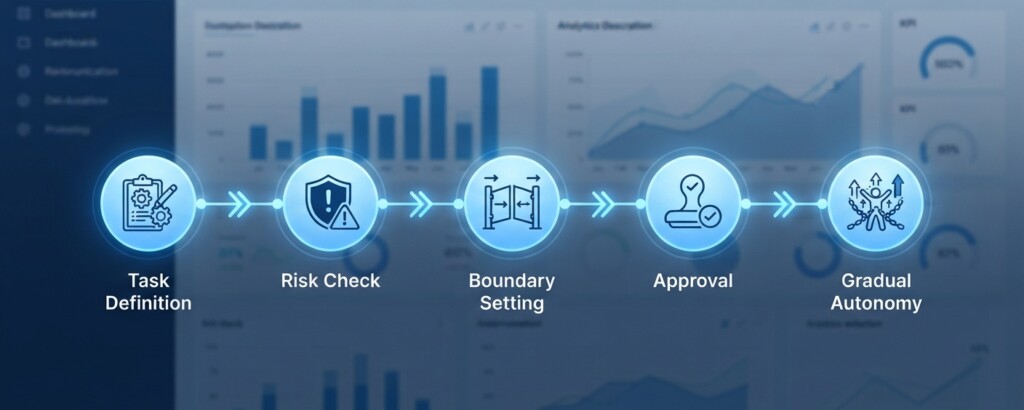
The most effective teams using AI agents do not just ‘turn on automation’ and hope for the best. They use a simple framework to decide what to hand off and how closely to supervise it. Here is a practical sequence you can apply to any task you are considering automating.
- Define the task precisely, including inputs, outputs, and the decision being made.
- Estimate the cost of a mistake — is it a typo in a social caption, or a misdirected $10,000 ad budget?
- Set boundaries the agent cannot cross, such as maximum daily spend or an approved list of claims about your product.
- Start with the agent in ‘suggest mode,’ where it proposes an action but a human approves it before it goes live.
- Review outputs weekly for the first month, checking for drift away from your brand voice or strategic goals.
- Expand autonomy gradually only for tasks that have passed review consistently, and keep spot-checking even then.
This sequence matters because risk is not static. A task that seemed safe to automate in January can become risky in March if your product positioning changes or a competitor shifts the market. Treat delegation as something you revisit, not something you set once and forget.
Real-World Use Cases That Show the Balance
Consider a mid-sized ecommerce company running paid search and paid social simultaneously. Their AI agent monitors cost-per-acquisition across both channels hourly and shifts small amounts of budget toward whichever channel is performing better that day. This is a strong use case: the decision is reversible, the stakes per adjustment are small, and the agent is working within a pre-set daily cap approved by the marketing manager. The human strategist still decides the total monthly budget, the overall channel mix, and which products get featured — the agent just fine-tunes within those guardrails.
Now consider a different scenario: a B2B software company let an AI content agent generate and publish blog posts fully unsupervised to hit a volume target. Within two months, search rankings for several money-pages actually dropped. The agent had been optimizing for keyword density and length, not for the nuanced expertise their audience expected, and it had quietly drifted from the company’s point of view on several technical topics. The fix was not abandoning the tool — it was reinstating an editorial review step before publishing and giving the agent a tighter brief with explicit examples of the brand’s voice and claims it was allowed to make.
A third example involves email marketing. A retail brand used an agent to personalize subject lines and send times for its newsletter list. Open rates rose nearly 15 percent within a quarter. The agent was never given control over offer strategy or discount amounts — those decisions stayed with the marketing team, who had seen in the past how automated discounting can erode margin quickly if left unchecked.
Do not let an AI agent have standing access to change pricing, discounts, or promotional offers without a human sign-off. Margin erosion from automated discounting is one of the most common and costly mistakes teams report after adopting AI agents.
Keeping Strategic Control as You Scale Automation
As you add more AI agents across more channels, the biggest threat is not any single bad decision — it is the slow accumulation of small drifts that nobody notices until performance has already slipped. Build in checkpoints that catch this early. A simple monthly audit works well: pull a sample of agent-generated content or decisions, compare them against your original brand and strategy guidelines, and note anything that feels ‘off,’ even if it is not technically wrong.
It also helps to keep a single person accountable for each agent, even if multiple people use its output. Shared ownership often means no one actually checks in, because everyone assumes someone else is watching. Name an owner for your SEO agent, a different owner for your paid media agent, and so on, even on small teams.
Finally, remember that strategy is the part of marketing that reflects judgment about your market, your customers, and your company’s voice — things an algorithm can mimic but not originate. AI agents are excellent at execution, not at deciding what your business should stand for this quarter. Keep that distinction visible in how you structure your team’s workflow, and automation will make you faster without making you generic.
Key Takeaways
- AI marketing agents are best suited to repetitive, reversible tasks across SEO, paid ads, email, and social media.
- Separate task automation (mechanical steps) from decision automation (judgment calls), and automate the former more freely than the latter.
- Use a delegation framework: define the task, estimate risk, set boundaries, start in suggest mode, then expand autonomy gradually.
- Review agent output regularly, since strategic drift tends to happen slowly and quietly rather than all at once.
- Keep pricing, offers, and brand voice decisions under human control, since these carry the highest cost if automation gets them wrong.
- Assign clear ownership for each AI agent so monitoring does not fall through the cracks on a busy team.
AI marketing agents genuinely do change how much a small team can accomplish, but the teams getting the best results are not the ones automating the most — they are the ones automating the right things, with clear boundaries and regular review. Treat these tools as capable assistants that need direction, not as autopilot for your strategy, and you will get the speed benefits without losing the judgment that makes your marketing actually work.
Want to Build a Smarter AI-Assisted Marketing Workflow?
Explore more practical guides on digital marketing strategy, automation, and analytics to help your team work faster without losing control of the big picture.