
Sending the same email to your entire list is like handing out the same flyer to every person on the street, regardless of what they actually want. Email list segmentation fixes that problem by dividing subscribers into smaller groups based on shared characteristics, so each group gets messages that actually matter to them. In this article, you will learn what email list segmentation is, which criteria work best for grouping subscribers, how to build a segmentation strategy step by step, and how to measure whether your segments are actually improving opens and conversions.
What Email List Segmentation Actually Means
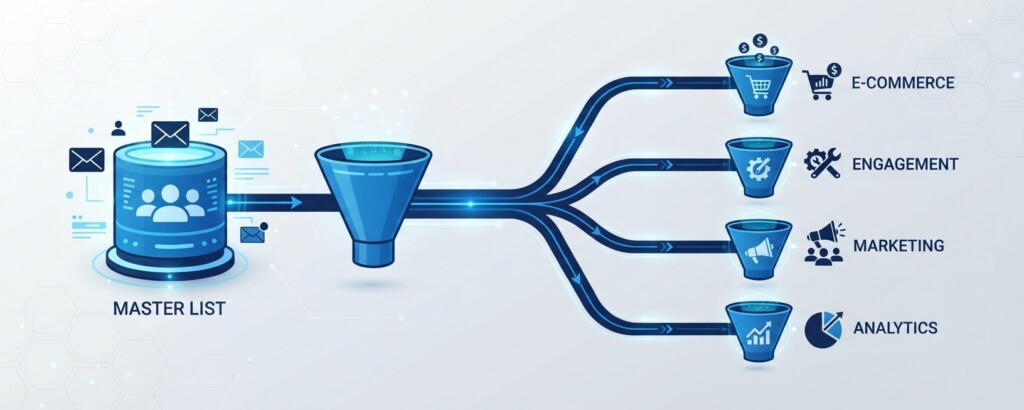
Email list segmentation is the practice of splitting your subscriber list into smaller groups based on specific traits, behaviors, or preferences, then tailoring your messaging to each group. Instead of one broadcast email going to 10,000 people, you might send five variations of that email to five groups of 2,000, each with subject lines, offers, and content adjusted to what that group cares about.
The logic is simple: relevance drives engagement. A subscriber who bought running shoes last month is more likely to open an email about running apparel than one about hiking boots. A subscriber who has not opened an email in six months needs a very different message than someone who opens every single campaign. Segmentation lets you speak to people based on where they actually are, not where your average subscriber might be.
Most email service providers, including Mailchimp, Klaviyo, HubSpot, and ActiveCampaign, offer built-in segmentation tools. The technology is rarely the bottleneck. The real work is deciding which data points matter and building a repeatable process around them.
The Core Segmentation Criteria Marketers Rely On
There is no single correct way to segment a list. The right approach depends on your business model, the data you collect, and what you are trying to achieve. That said, most effective segmentation strategies pull from a handful of proven categories.
- Demographic data: age, location, job title, industry, or company size, useful for B2B lists and businesses with geographically specific offers.
- Behavioral data: what subscribers click, purchase, browse, or ignore, which tends to be the strongest predictor of future engagement.
- Engagement level: how often someone opens or clicks your emails, used to separate active subscribers from at-risk or dormant ones.
- Purchase history: what someone bought, how much they spent, and how often they buy, useful for upsells, cross-sells, and loyalty campaigns.
- Lifecycle stage: whether someone is a new lead, a first-time buyer, a repeat customer, or a lapsed customer.
- Source of signup: where the subscriber joined your list, such as a lead magnet, a webinar, or a checkout page, which hints at their original intent.
Behavioral and engagement-based segments tend to outperform purely demographic ones because they reflect actual interest rather than assumed interest. Knowing someone lives in Chicago tells you little about whether they want your product. Knowing they clicked on a specific product category three times in the past week tells you a lot.
Start with two or three segments, not twenty. Over-segmenting before you have enough data per group leads to tiny audiences and unreliable results. Build complexity gradually as you learn what actually moves the needle.
Building a Segmentation Strategy Step by Step
A segmentation strategy is not a one-time project, it is an ongoing system. Here is a practical process you can apply regardless of list size or industry.
- Audit your current data. Look at what information you already collect through signup forms, purchase records, and website tracking. Identify gaps where you might need to ask subscribers directly.
- Define your segmentation goals. Decide whether you are trying to increase opens, reduce unsubscribes, boost repeat purchases, or re-engage inactive subscribers, since the goal determines which criteria matter most.
- Choose two or three starting segments. Common first segments include new subscribers, highly engaged subscribers, and inactive subscribers who have not opened an email in 90 days or more.
- Build tailored content for each segment. A welcome series for new subscribers looks nothing like a win-back campaign for dormant ones, even if both come from the same brand.
- Test and measure results separately. Compare open rates, click-through rates, and conversions across segments rather than looking at one blended average.
- Refine based on performance. Merge segments that behave similarly, split ones that show mixed results, and retire segments that no longer serve a clear purpose.
A mid-sized online retailer, for example, might start with three segments: subscribers who purchased in the last 30 days, subscribers who browsed products but did not buy, and subscribers who have not engaged in over 90 days. Each group gets a different email cadence and offer. Recent buyers might receive a post-purchase review request, browsers might get a reminder with a small discount, and dormant subscribers might get a direct re-engagement email asking if they still want to hear from the brand.
Segmentation in Action: A Practical Example
Consider a B2B software company selling project management tools. Their list includes free trial users, paying customers, inactive subscribers, and people who downloaded a whitepaper but never signed up for a trial. Sending the same monthly newsletter to all of these groups wastes an opportunity. Instead, the free trial users could receive onboarding tips and feature walkthroughs timed to their trial period. Paying customers could receive advanced tips, case studies, and upsell offers for premium features. Inactive subscribers could receive win-back campaigns, while whitepaper downloaders who never converted could receive educational content designed to build trust before any sales pitch.
The table below shows how this might break down in practice, including sample messaging goals and expected engagement patterns for each segment.
| Segment | Primary Goal | Sample Content | Typical Open Rate Lift |
|---|---|---|---|
| Free trial users | Drive activation and feature adoption | Onboarding tips, tutorial videos, deadline reminders | 15–25% higher than general list |
| Paying customers | Increase retention and upsell revenue | Advanced tips, case studies, loyalty offers | 10–20% higher than general list |
| Inactive subscribers | Re-engage or clean the list | Win-back offers, preference surveys | Often lower opens but higher relevance |
| Whitepaper downloaders | Build trust toward conversion | Educational series, customer stories | 5–15% higher than general list |
Notice that the inactive segment is expected to show lower open rates. That is normal and even useful information. Rather than treating low engagement as a failure, use it to decide which subscribers should be removed from your list entirely, since a smaller, more engaged list almost always outperforms a larger, unresponsive one on deliverability and sender reputation.
Avoid using too many overlapping segments for the same campaign, such as sending both a general promotional email and a highly targeted behavioral email to the same person within a short window. This creates inbox fatigue and can increase unsubscribe rates even among engaged subscribers.
Measuring Whether Your Segmentation Is Working
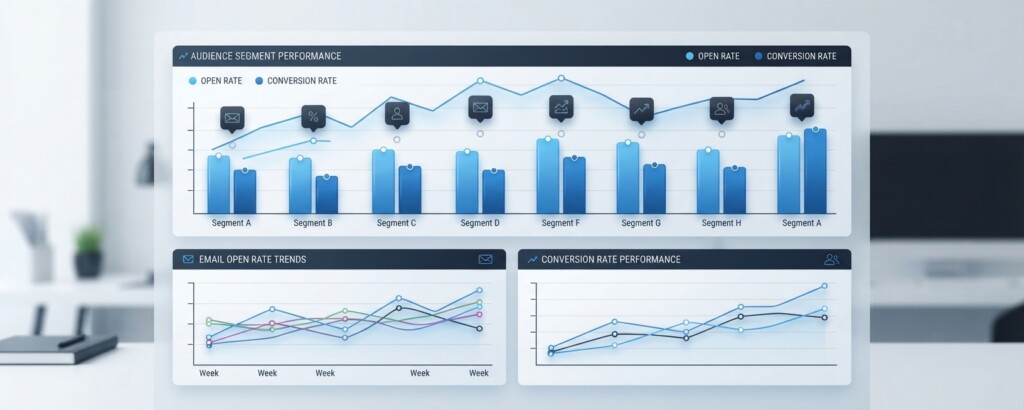
Segmentation only matters if it produces better results than a one-size-fits-all approach. Track these metrics at the segment level, not just across your entire list:
- Open rate by segment, to see which groups respond to which subject lines and send times.
- Click-through rate by segment, which shows whether your content resonates once the email is opened.
- Conversion rate by segment, tracking actual purchases, signups, or whatever action matters to your business.
- Unsubscribe and spam complaint rate by segment, which flags content that feels irrelevant or overly frequent.
- List growth and churn by segment, especially useful for understanding how lifecycle stages shift over time.
Run A/B comparisons between a segmented campaign and a generic send whenever possible. Many marketers find that segmented campaigns produce noticeably higher open and click rates compared to blanket sends, though exact lift varies by industry and list quality. The important thing is testing your own list rather than assuming industry averages apply directly to your audience.
| Generic campaign open rate | 18% |
| Segmented campaign open rate (engaged group) | 31% |
| Segmented campaign open rate (new subscriber group) | 27% |
| Lift range from segmentation | 9–13 percentage points |
Review your segments at least quarterly. Subscriber behavior shifts, products change, and a segment that made sense six months ago may no longer reflect how your audience actually behaves today.
Key Takeaways
Email list segmentation strategies work because they replace guesswork with relevance. By grouping subscribers based on behavior, engagement level, lifecycle stage, or purchase history, you send messages that match where each person actually is, which consistently leads to higher opens and stronger conversions than blanket emails. Start small with two or three meaningful segments, measure performance at the segment level rather than relying on list-wide averages, and refine your approach as you learn what drives engagement for your specific audience. The goal is not to create as many segments as possible, it is to create the right ones that genuinely change how subscribers respond.
Ready to Build Smarter Email Campaigns?
Explore more practical guides on email marketing, analytics, and campaign strategy to keep sharpening your digital marketing skills.