
You spend money on search ads, social posts, email campaigns, and content marketing, then a customer buys — but which channel actually gets the credit? That is the question marketing attribution models are built to answer. In this article, you will learn what attribution models are, how the most common ones work, when to use each one, and how to pick a model that fairly credits your campaigns instead of accidentally starving your best-performing channels of budget.
By the end, you should be able to look at your own customer journey data and confidently choose a model that matches your business, your sales cycle, and your reporting tools — without needing a data science degree to do it.
What Marketing Attribution Actually Means
Marketing attribution is the process of assigning credit for a conversion — a sale, a lead, a signup — to the marketing touchpoints that led to it. A touchpoint is any interaction a potential customer has with your brand: clicking a paid ad, reading a blog post, opening an email, seeing a social post, or typing your brand name into a search bar.
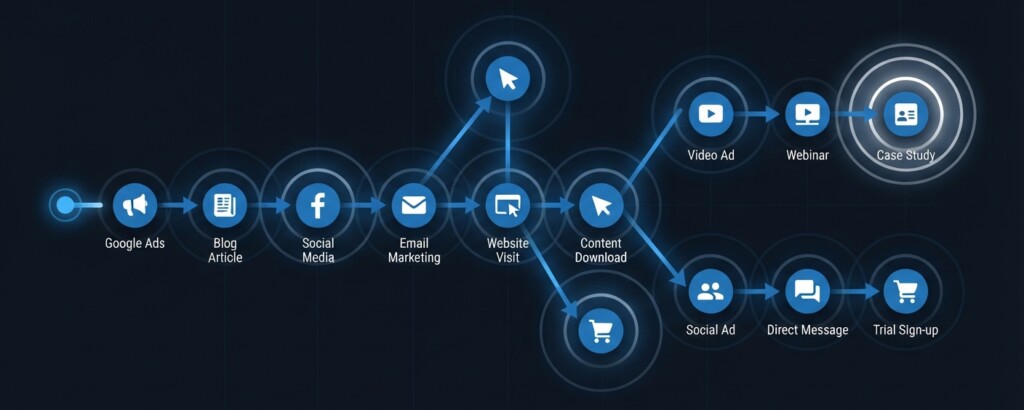
Most customers do not convert on the first interaction. Someone might discover you through a Google search, read a blog post two days later, see a retargeting ad the following week, then finally convert after clicking an email link. Attribution models decide how much credit each of those four touchpoints gets. Get the model wrong, and you might cut budget from the channel that actually started the journey, or over-invest in the channel that just happened to close the deal.
Attribution is not about finding the one perfect answer — it is about choosing a model that reflects how your customers actually behave and that you can consistently apply across campaigns.
The Main Attribution Models and How They Work
There are several standard models used across marketing analytics and reporting platforms. Each one distributes credit differently, and each tells a different story about your marketing performance.
- First-touch attribution: gives 100 percent of the credit to the very first interaction a customer had with your brand. Good for understanding what drives awareness and top-of-funnel discovery.
- Last-touch attribution: gives 100 percent of the credit to the final interaction before conversion. This is the default in many basic analytics setups and tends to overvalue bottom-funnel channels like branded search or retargeting.
- Last non-direct click: similar to last-touch, but ignores direct traffic (someone typing your URL directly) and credits the last channel before that. Useful because direct visits often hide the real influencing channel.
- Linear attribution: splits credit equally across every touchpoint in the journey. Simple and fair on the surface, but it treats a brief ad impression the same as a deep content engagement.
- Time-decay attribution: gives more credit to touchpoints that happened closer to the conversion, with earlier touchpoints receiving progressively less. Useful for longer sales cycles where recent interactions tend to matter more.
- Position-based (U-shaped) attribution: gives the most credit — often 40 percent each — to the first and last touchpoints, with the remaining credit split among the middle interactions. This model values both discovery and closing moments.
- Data-driven attribution: uses statistical modeling or machine learning to assign credit based on actual patterns in your conversion data, rather than fixed rules. This is now the standard default attribution model in platforms like Google Ads and GA4, which retired rule-based models like linear, time-decay, first-click, and position-based in 2023.
None of these models is universally correct. Each one answers a slightly different question, and the right choice depends on your sales cycle length, how many channels you run, and the capabilities of your reporting tools.
Choosing the Right Marketing Attribution Model for Your Business
The best marketing attribution model is the one that matches how your customers actually shop, not the one that is easiest to set up. Here is a practical way to think through the decision.
Start with your sales cycle length. If customers convert within minutes or hours of first contact, such as an impulse purchase from a social ad, last-touch or last-non-direct-click models are usually accurate enough. If your sales cycle spans weeks or months, such as B2B software or high-ticket purchases, single-touch models will badly misrepresent your funnel because they ignore all the nurturing that happened along the way.
Next, consider how many channels you actively run. A business running only Google Search ads and email does not need a complex custom setup — a simpler rule-based or default last-click view will likely give a clear enough picture. A business running search, social, display, affiliate, content, and email simultaneously benefits far more from data-driven or multi-touch attribution models, because the interactions between channels are harder to untangle manually.
Finally, be honest about your data volume. While platforms like Google Ads and GA4 have made data-driven attribution the default without strict minimum eligibility thresholds, machine-learning models still need substantial conversion volume — typically hundreds per month — to produce stable, dependable statistical patterns. If conversion volume is very low, algorithmic modeling can be noisy, and teams using platforms that support rule-based alternatives or last-click reporting may find those simpler options more transparent and predictable.
| Model | Best For | Watch Out For |
|---|---|---|
| Array | Array | Array |
| Array | Array | Array |
| Array | Array | Array |
| Array | Array | Array |
| Array | Array | Array |
| Array | Array | Array |
Do not mix attribution models across teams or reports without labeling them clearly. It is common for a paid media team to report last-click results while a content team reports first-touch results — leading to double-counted credit and budget arguments that are really just a measurement mismatch, not a performance disagreement.
Applying Attribution Models: A Real-World Example
Consider a mid-sized B2B software company selling a project management tool with an average sales cycle of six weeks. A prospective customer’s journey might look like this: they find a blog post through organic search in week one, click a LinkedIn ad in week three, open a nurture email in week four, and finally convert after clicking a retargeting ad in week six.
Under last-touch attribution, the retargeting ad gets all the credit, making it look like the company’s best-performing channel. Paid media budget would likely shift further toward retargeting, while the blog post that originally attracted the prospect gets zero recognition and may even be deprioritized in content planning.
Under position-based attribution, the organic blog post and the retargeting ad would each receive 40 percent of the credit, with the LinkedIn ad and email nurture splitting the remaining 20 percent. This paints a much more balanced picture: content marketing gets credit for starting the relationship, paid media gets credit for closing it, and the middle-funnel touches still get some recognition rather than being ignored entirely.
This is why many B2B marketers with multi-week sales cycles prefer multi-touch frameworks like position-based or time-decay models in tools that support them — they better reflect the reality that discovery and closing are both valuable, even if they are not equally weighted.

Common Pitfalls When Setting Up Attribution
Even with the right model chosen, attribution can go wrong in practice. Here are the mistakes worth avoiding.
- Relying on a single platform’s built-in attribution without cross-checking it against a broader analytics view — each ad platform tends to over-credit itself when measured in isolation.
- Ignoring offline and assisted conversions, such as phone calls or in-person sales, which can leave large gaps in the customer journey data.
- Switching models frequently, which makes it impossible to compare performance trends over time.
- Forgetting that attribution models only account for tracked digital touchpoints, missing influences like word-of-mouth, brand recognition, or offline advertising.
- Treating attribution data as absolute truth rather than a directional guide for budget decisions.
A good practice is to review your attribution model choice once or twice a year, not with every campaign. Frequent changes make it impossible to spot real performance trends versus measurement noise.
Key Takeaways
Marketing attribution models exist to answer a simple but important question: which of your campaigns actually deserve credit for driving results? First-touch and last-touch models are easy to understand but tell an incomplete story. Multi-touch models such as linear, time-decay, and position-based offer balanced views in platforms that support them, though major ad ecosystems like Google Ads and GA4 have streamlined their native models around data-driven and last-click attribution. Data-driven attribution can be powerful, but its machine-learning algorithms work best when supported by steady conversion volume.
The right choice depends on your sales cycle, your channel mix, and your data volume — not on which model is trendiest or easiest to set up in your ad platform. Whatever model you choose, apply it consistently, document it clearly for your team, and revisit it periodically rather than reactively. Fair credit for your campaigns leads to smarter budget decisions and a clearer picture of what is actually growing your business.
Want to go deeper on marketing measurement?
Explore more practical guides on analytics, campaign strategy, and marketing frameworks to help you make sharper, data-backed decisions across every channel.