
If you are guessing how much to spend to acquire a new customer, you are either leaving money on the table or quietly bleeding your budget dry. Customer lifetime value calculation gives you the missing number: how much a customer is actually worth to your business over time, not just on their first purchase. Once you know that number, setting acquisition budgets stops being a gut-feel exercise and becomes a repeatable, defensible process. In this article, you will learn what customer lifetime value (CLV) actually means, how to calculate it with a formula you can use today, how to translate that number into acquisition spending limits, and where marketers commonly get the math wrong.
What Customer Lifetime Value Actually Measures
Customer lifetime value is the total revenue (or profit, in more advanced versions) a business can expect from a single customer across the entire time that customer stays active. It answers a simple but important question: is this customer worth more than what we spent to get them?
Marketers often focus on cost per acquisition (CPA) in isolation, which is a mistake. A CPA of $150 sounds expensive until you realize that customer sticks around for three years and spends $2,000 total. Without CLV, you would reject a perfectly profitable acquisition channel because you only looked at the upfront cost.
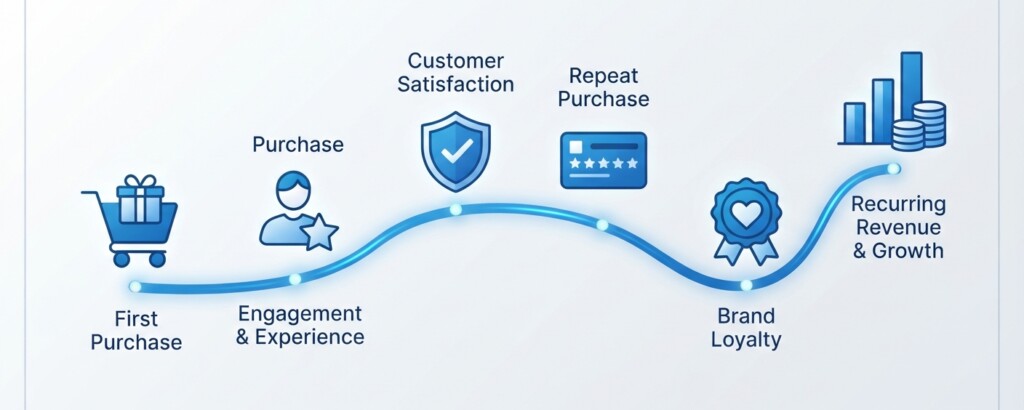
CLV connects three parts of the business that are usually managed by different teams: marketing (acquisition cost), sales or product (purchase behavior), and customer success (retention). When you calculate it properly, you are forced to look at the whole customer journey instead of just the top of the funnel.
The Practical CLV Formula You Can Use Today
There are complex, statistically modeled versions of CLV used by data science teams, but most marketing managers and small business owners do not need that level of sophistication to make good budgeting decisions. The practical formula below gets you 80 to 90 percent of the way there with data you likely already have.
The basic formula is: CLV = Average Order Value x Purchase Frequency x Customer Lifespan. From there, you can refine it by factoring in gross margin to get a profit-based CLV, which is the version you should actually use for budgeting decisions.
| Average Order Value (AOV) | $80 |
| Purchase Frequency (per year) | 4 |
| Customer Lifespan (years) | 3 |
| Revenue-based CLV (AOV x Frequency x Lifespan) | $960 |
| Gross Margin | 40% |
| Profit-based CLV (Revenue CLV x Margin) | $384 |
Walking through this: a customer spends $80 per order, buys four times a year, and stays a customer for three years. That gives you $960 in lifetime revenue. But revenue is not profit — you still have to pay for goods, fulfillment, and overhead. If your gross margin is 40 percent, your actual profit-based CLV is $384. That $384 figure, not the $960, is what you should be comparing against your acquisition costs.
Always budget acquisition spend against profit-based CLV, not revenue-based CLV. Revenue looks impressive on a slide, but it is profit that actually funds your marketing, payroll, and growth.
Turning CLV Into an Acquisition Spending Rule
Once you have a profit-based CLV figure, the next step is deciding what portion of it you are willing to spend to acquire a customer. This is where most businesses either overspend chasing growth or underspend out of excessive caution.
A common industry benchmark is the CLV to CAC ratio (Customer Lifetime Value to Customer Acquisition Cost). A ratio of 3:1 is considered healthy for many subscription and e-commerce businesses — meaning you earn three dollars in lifetime profit for every dollar spent acquiring the customer. A ratio below 1:1 means you are losing money on every customer you bring in, even if individual sales look fine on paper. A ratio much higher than 5:1 can actually signal that you are underinvesting in growth and leaving market share on the table.
| CLV:CAC Ratio | What It Means | Suggested Action |
|---|---|---|
| Below 1:1 | Losing money per customer acquired | Pause spend, fix pricing, margin, or retention before scaling |
| 1:1 to 2:1 | Marginally profitable, high risk | Improve retention or reduce CAC before increasing budget |
| 3:1 | Healthy, sustainable balance | Maintain current strategy, test incremental scaling |
| 4:1 to 5:1 | Strong profitability | Consider increasing acquisition spend to grow faster |
| Above 5:1 | Possibly underinvesting | Test higher budgets or new channels to capture more volume |
Using the earlier example, with a profit-based CLV of $384, a 3:1 ratio means you could justify spending up to roughly $128 to acquire a single customer. That number becomes your maximum CAC across all channels combined — paid search, paid social, affiliate, email list building, and so on. Anything consistently above that threshold should be scrutinized or cut.
Do not apply the same CLV figure across every acquisition channel or customer segment without adjustment. Customers acquired through a discount-heavy promotion often have lower lifetime value and higher churn than those acquired through organic search or referrals. Blending all customers into one average CLV can mask channels that are quietly destroying profit.
Real-World Example: Applying CLV Across Two Channels
Consider a mid-sized online retailer running both Google Ads and an influencer partnership program. On the surface, Google Ads has a higher CPA of $95, while the influencer channel brings in customers at a lower CPA of $60. A marketing manager looking only at acquisition cost would shift more budget toward influencers.
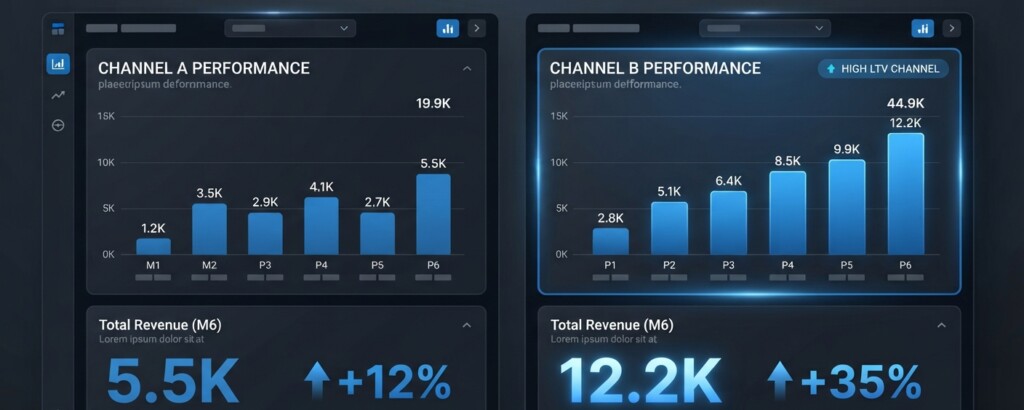
But when the team segments CLV by channel, a different picture emerges. Customers from Google Ads tend to be searching with purchase intent already, and they show a 3-year average lifespan with four purchases a year — producing the $384 profit-based CLV calculated earlier. Influencer-driven customers, however, are often one-time bargain shoppers responding to a limited-time code; their average lifespan is closer to five months with only 1.5 purchases, producing a profit-based CLV closer to $70.
| Channel | CPA | Profit-Based CLV | CLV:CAC Ratio | Verdict |
|---|---|---|---|---|
| Google Ads | $95 | $384 | 4.0:1 | Strong, scale with confidence |
| Influencer Program | $60 | $70 | 1.2:1 | Marginal, needs optimization |
This is the real value of calculating CLV by channel rather than relying on a single company-wide average: it reveals that the channel with the lower upfront cost was actually the weaker investment. Without this analysis, the retailer would have shifted budget in the wrong direction and reduced overall profitability while believing they were being efficient.
Common Mistakes That Distort CLV Calculations
Even a simple formula can produce misleading results if the inputs are wrong. Here are the most frequent errors marketers make when calculating and applying CLV.
- Using revenue instead of profit margin, which inflates how much you can afford to spend on acquisition.
- Calculating customer lifespan from too short a data window, especially for newer businesses that have not yet seen a full customer lifecycle play out.
- Averaging CLV across all customers and channels instead of segmenting by acquisition source, product line, or customer tier.
- Ignoring customer acquisition cost components beyond media spend, such as creative production, tools, and staff time.
- Failing to revisit CLV regularly; pricing changes, churn rate shifts, and new competitors can change the number significantly within a year.
It is worth noting that CLV should be treated as a living number, recalculated quarterly or at minimum twice a year, rather than a figure you set once and forget. Businesses that review CLV only annually often continue funding underperforming channels for months after the data has already turned against them.
If you are a small business without a data team, you can still estimate CLV reasonably well using order history from your point-of-sale or e-commerce platform. Most platforms report average order value and purchase frequency natively — you mainly need to estimate average customer lifespan from repeat purchase patterns.
Key Takeaways
- Customer lifetime value calculation turns acquisition spending from a guess into a measurable, budget-driving decision.
- The practical formula is Average Order Value x Purchase Frequency x Customer Lifespan, then multiplied by gross margin for a profit-based figure.
- Use a CLV to CAC ratio, with 3:1 as a common healthy benchmark, to set a maximum acceptable acquisition cost.
- Segment CLV by channel and customer type rather than relying on one blended average, since acquisition sources can have very different lifetime values.
- Revisit your CLV numbers regularly, since churn, pricing, and market conditions shift the calculation over time.
Getting comfortable with customer lifetime value calculation is one of the highest-leverage skills a marketer can develop, because it directly connects marketing activity to business profitability. Once you can confidently say what a customer is worth and what you can afford to spend to earn their business, budgeting conversations with leadership become far easier to navigate and defend.
Want to sharpen more of your budgeting and strategy skills?
Explore more practical guides on marketing analytics, acquisition strategy, and campaign budgeting frameworks built for real-world decision-making.