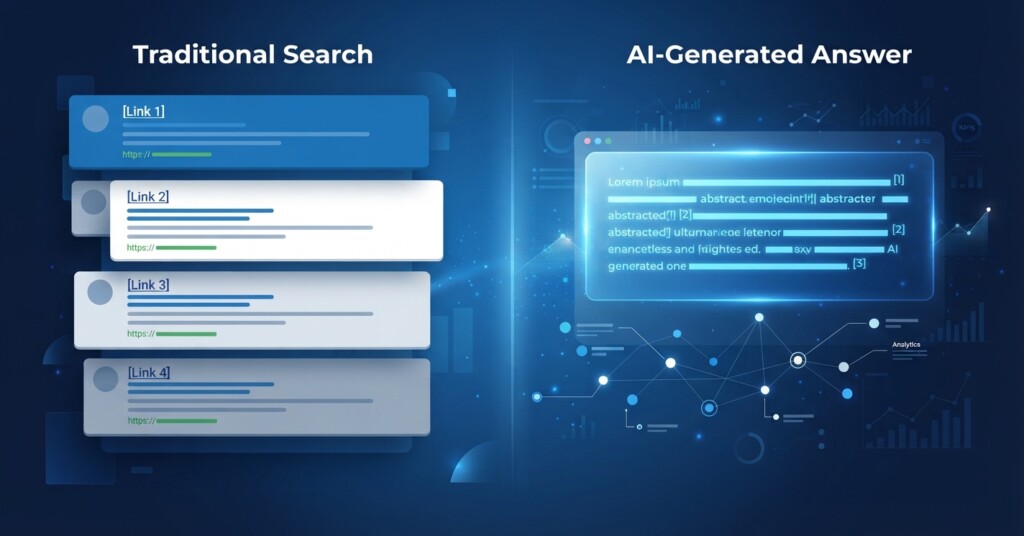
Search behavior has changed faster in the last two years than in the previous decade. Instead of typing a query into Google and clicking through ten blue links, people now ask ChatGPT a question and get a synthesized answer. They search Perplexity and read a summary with citations. They type into Google and see an AI Overview sitting above the traditional results. Answer Engine Optimization, or AEO, is the practice of structuring and writing your content so these AI systems can understand it, trust it, and cite it as a source. This article walks through what AEO actually means, how it differs from traditional SEO, and the specific tactics that increase your odds of being the source an AI engine quotes.
What Answer Engine Optimization Actually Means
Traditional SEO optimizes for ranking: you want to be the top blue link so a human clicks through to your site. Answer Engine Optimization optimizes for something different — being selected and referenced inside a generated answer. The reader may never click your link at all. They might just read the AI’s summary and move on, with your brand mentioned as the source in a small citation or footnote. This matters because the mechanics of being chosen are not identical to the mechanics of ranking. Large language models and retrieval-based answer engines like Perplexity do not rank pages the same way a classic search algorithm does. They retrieve chunks of text, evaluate how well those chunks answer the specific question asked, and then decide whether to summarize, paraphrase, or directly quote. A page can rank on page one of Google and still never get pulled into an AI Overview, because the content is not structured in a way the model finds extractable.
Think of it this way: SEO gets you discovered. AEO gets you quoted. Both matter, but the second one is newer, less understood, and currently has far less competition — which is exactly why it is worth learning now.
Early mover’s advantage: Most competitors have not adjusted their content for answer engines yet. Teams that restructure even a handful of high-intent pages this quarter often see citations appear within weeks, simply because so little well-structured competing content exists for AI systems to choose from.

How AI Engines Choose What to Cite
To optimize for something, you need to understand the selection process. While each platform has its own retrieval system, three patterns show up consistently across ChatGPT browsing, Perplexity, and Google AI Overviews. First, these systems favor content that directly and unambiguously answers a specific question within the first few sentences of a section. If a user asks what email open rate is considered good, and your article buries that number in paragraph nine after three paragraphs of history, the model has to work harder to extract it. Content that states the answer plainly, then explains the reasoning, gets pulled more often than content that builds up to a conclusion. Second, these engines weight credibility signals heavily, including author expertise, citations to primary data, publication recency, and whether other reputable sites reference the same page. This is sometimes called E-E-A-T in SEO circles — Experience, Expertise, Authoritativeness, and Trustworthiness — and it carries over directly into AI retrieval because the models are trained to avoid repeating low-quality or unverified claims. Third, format matters enormously. Lists, tables, defined terms, and clearly labeled sections are easier for a model to lift cleanly than dense paragraphs of narrative prose. If your content answers a question but the answer is wrapped in marketing language and tangents, the model may skip it in favor of a competitor’s cleaner version of the same fact.
| Traditional SEO Focus | Answer Engine Optimization Focus |
|---|---|
| Keyword density and placement | Direct, extractable answers to specific questions |
| Backlink volume | Citation-worthy data, original research, and clear sourcing |
| Meta descriptions for click-through | Concise summaries that work standalone, without a click |
| Long-form content for dwell time | Modular sections that can be lifted independently |
| Ranking position on page one | Inclusion inside the generated answer itself |
Structuring Content So Models Can Extract It
Once you understand what these systems reward, the actual writing changes become fairly concrete. Start every important section with a direct answer sentence, then expand on it. If you are writing about what a good click-through rate is for email marketing, the first sentence of that section should state the benchmark number, not ease into it with a story about how email marketing has evolved. Use question-based subheadings that mirror how people actually type into ChatGPT or Perplexity. Instead of a heading like Open Rate Benchmarks, try What Is a Good Email Open Rate in 2025. This does two things: it matches the phrasing of real queries, and it gives the model a clean question-answer pair it can extract as a unit. Break up dense explanations with lists and tables wherever you are presenting multiple data points, steps, or comparisons. A numbered list of five steps is far easier for a retrieval system to parse and present than the same five steps written as a flowing paragraph. Tables are especially powerful for AEO because they present structured comparisons that models can summarize accurately without misrepresenting the relationships between data points. Include original statistics, survey results, or proprietary data whenever possible. AI engines are increasingly cautious about repeating unverified claims, so content backed by a named source, a dataset, or first-party research tends to get cited more than generic restatements of common knowledge. If you run a small business and survey your own customers, that small dataset — properly labeled with sample size and date — can become one of your most cited assets. Finally, keep author and publication information visible and specific. A byline with a real name, a role, and a brief credential line signals to both human readers and retrieval systems that the content has a traceable, accountable source.
- Lead each major section with a one or two sentence direct answer before adding context or nuance.
- Write subheadings as natural-language questions that match how people phrase voice and chat queries.
- Convert comparisons, steps, and benchmarks into tables or numbered lists instead of narrative paragraphs.
- Add original data, surveys, or case studies with clear sourcing and dates attached.
- Keep author bylines, publication dates, and credentials visible near the top of the page.
Do not try to game this by stuffing question-style headings onto content that does not actually answer the question. AI engines cross-reference multiple sources before citing, and content that overpromises in the heading but underdelivers in the body gets filtered out quickly — and can damage trust signals for your domain over time.
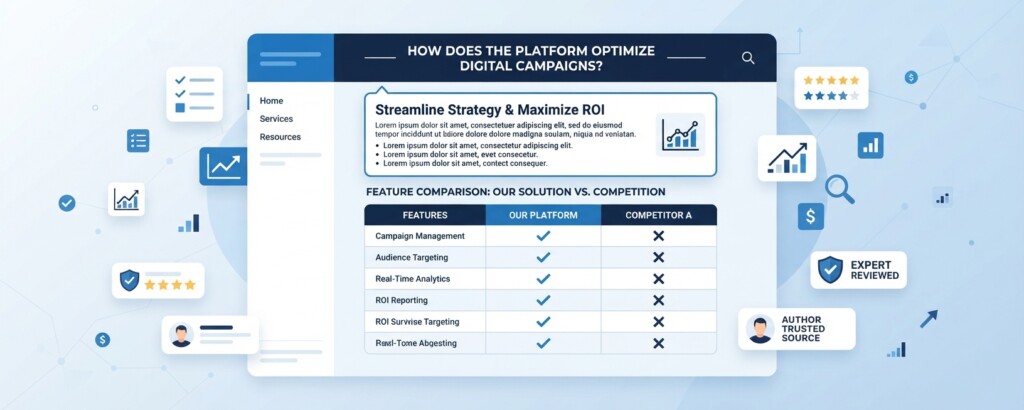
A Practical Framework for Auditing Existing Content
You do not need to rewrite your entire site to start seeing results. A focused audit of your highest-traffic or highest-intent pages is a more efficient starting point. Begin by identifying five to ten pages that already rank well in traditional search and cover topics where people commonly ask follow-up questions — pricing comparisons, how-to processes, definitions, and benchmark data are strong candidates. For each page, ask three questions. Does the page answer a specific question within the first two sentences of its relevant section, or does it take several paragraphs to get there? Is there at least one list or table that a model could lift cleanly without losing meaning? And does the page include any original data or a clearly credentialed author, or is it a generic restatement of information available everywhere else? Pages that fail all three checks are good candidates for a structural rewrite. Pages that already rank well but lack the extractable formatting are often the fastest wins, since the authority is already there and only the structure needs to change. You can test progress by directly asking ChatGPT or Perplexity the exact questions your content answers and checking whether your brand appears in the response or the citation list. This is manual, but it is currently the most reliable feedback loop available since formal AEO analytics tools are still maturing.
| Pages audited for AEO readiness | 10 |
| Pages failing direct-answer test | 6 |
| Pages lacking tables or lists | 7 |
| Pages with no original data or named author | 5 |
| Priority rewrite candidates | 4 |
Treat this scoring exercise as a recurring process rather than a one-time project. Because answer engines update their retrieval behavior frequently and competitors are gradually catching on to AEO themselves, revisiting your top pages every quarter keeps you from losing ground once the easy wins have been claimed by others.
Key Takeaways
Answer Engine Optimization is not a replacement for SEO — it is an additional layer that determines whether your content gets quoted inside AI-generated answers rather than just ranked in a list of links. The core principles are straightforward even if the execution takes discipline: answer questions directly and early, format information so it can be extracted cleanly, back claims with original or well-sourced data, and make authorship and credibility visible. Engines like ChatGPT, Perplexity, and Google AI Overviews all reward some version of these behaviors because they are fundamentally trying to serve a confident, accurate answer to a human being as efficiently as possible. The brands that structure their content around that goal, rather than around old-style keyword tactics, are the ones showing up inside the answers themselves.
Want more practical frameworks like this one?
If this breakdown of Answer Engine Optimization was useful, explore more structured, no-fluff guides on SEO, content strategy, and AI’s growing role in marketing. Build the skills that keep your work relevant as search itself keeps changing.