
Every website has pages quietly losing traffic, rankings, and credibility — and most marketers do not find out until the damage shows up in a quarterly report. An SEO content audit is the process of systematically reviewing your existing pages to spot the ones that are underperforming, figure out why, and fix them before they pull down your site’s overall authority. This article walks you through exactly how to run one, step by step, so you can turn stale content into a ranking asset instead of a liability.
Why Underperforming Pages Hurt More Than You Think
Search engines do not evaluate pages in isolation. They assess patterns across your entire domain — thin content, outdated statistics, duplicate topics, and unhelpful pages all send signals about the overall quality of your site. A handful of weak pages can quietly suppress how much trust search engines place in your stronger content, a phenomenon often described informally as content dilution.
Underperforming pages typically fall into a few buckets: pages that never ranked, pages that ranked once and declined, pages with high impressions but almost no clicks, and pages that technically rank but no longer match what searchers actually want. Each of these requires a different diagnosis and a different fix, which is exactly why a structured audit matters more than a quick skim through your blog archive.
Rule of thumb: if a page has not been updated in over 12 months and ranks outside the top 20 for its target keyword, it is a strong candidate for your audit shortlist.
Step One: Pull the Right Data Before You Judge Any Page
A good audit starts with data, not opinion. Before deciding a page is underperforming, gather the following from Google Search Console, your analytics platform, and an SEO crawler tool: organic clicks and impressions over the last 12 months, average position for target keywords, click-through rate, bounce rate or engagement rate, backlinks pointing to the page, and the publish or last-updated date.
Export this into a single spreadsheet so you can compare pages side by side. Looking at metrics in isolation is misleading — a page with low traffic but strong engagement and rising impressions might just be new, while a page with declining clicks and a dropping average position is actively losing ground and needs attention now.
| Signal | What It Suggests | Typical Fix |
|---|---|---|
| High impressions, low clicks | Title or meta description is not compelling, or ranking position is too low | Rewrite title tag and meta description; improve on-page relevance |
| Declining clicks over 6+ months | Content is aging, a competitor outranked you, or search intent shifted | Refresh content, update data, re-align with current intent |
| High bounce rate, short time on page | Content does not match what the searcher expected | Rewrite intro, clarify headings, match search intent more precisely |
| Few or no backlinks, flat rankings | Low authority signal, content not seen as link-worthy | Add original data, expert quotes, or promote for outreach |
| Multiple pages targeting the same keyword | Keyword cannibalization splitting ranking signals | Consolidate into one authoritative page or differentiate intent |

Step Two: Categorize Every Page Into an Action Bucket
Once you have the data, resist the urge to fix pages one at a time as you find them. Instead, sort every page into one of four buckets: Keep, Improve, Consolidate, or Remove. This keeps the audit organized and prevents you from spending hours polishing a page that should really be merged or deleted.
- Keep: the page is ranking well, driving traffic, and matches current search intent — leave it alone or do light maintenance only.
- Improve: the page has potential (decent impressions, relevant topic, some backlinks) but is underperforming due to weak content, outdated information, or poor on-page optimization.
- Consolidate: two or more pages target the same or very similar keywords and are competing against each other instead of ranking together.
- Remove or redirect: the page has no traffic, no backlinks, no strategic value, and is not worth the investment to fix — redirect it to a stronger, related page instead of leaving it live.
A mid-size blog with 400 published posts will often find that roughly 60 to 70 percent fall into Keep, 20 to 25 percent need Improve, and the remainder should be consolidated or removed. If your numbers look very different, that is a signal worth investigating — either your content strategy has been inconsistent or your original keyword research was too scattered.
Do not delete or redirect pages based on traffic numbers alone. Check backlinks first. A low-traffic page with strong external links still passes authority to your site, and removing it carelessly can cost you ranking power elsewhere.
Step Three: Diagnose the Real Reason a Page Is Underperforming
This is the step most audits skip, and it is the one that actually determines whether your fixes work. Low rankings are a symptom, not a diagnosis. Before rewriting anything, ask what specifically changed or what was missing from the start.
Start by comparing your page against the current top-ranking pages for the same keyword. Look at word count, structure, media use, and most importantly, the type of content being rewarded. If the top results are now comparison tables and your page is a long narrative post, Google’s current preference for that keyword has shifted toward a different content format, not just better writing. Also check the publish dates of competing pages — if they were all updated in the last few months and yours was not, freshness is likely part of the problem.
Search intent drift is one of the most common and overlooked causes. A keyword that used to be informational can shift toward commercial intent as the market matures. For example, a page built around ‘best project management tips’ might have ranked well two years ago as a listicle, but if searchers today are mostly comparing software tools, Google will favor comparison-style content over general advice, regardless of how well-written your original post is.
Step Four: Fix, Consolidate, or Retire — and Track the Results
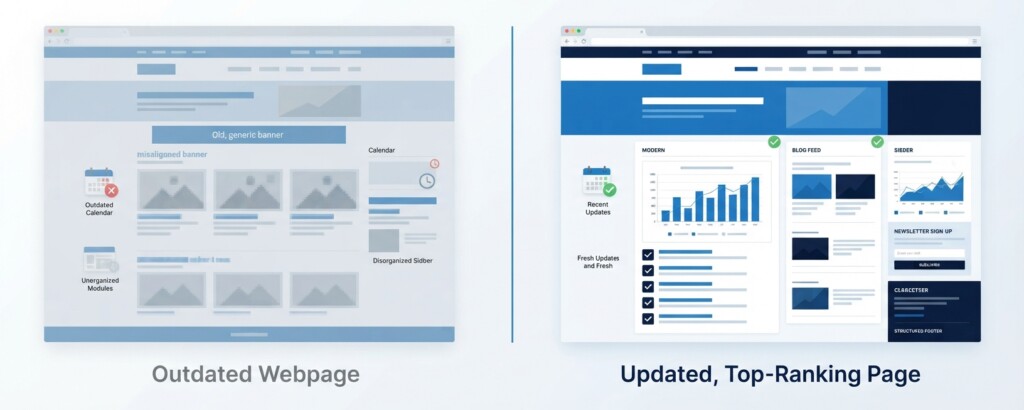
Once you know why a page is underperforming, the fix is usually one of four things: refresh the content with updated information and better structure, rewrite the title and meta description to improve click-through rate, merge it with a stronger page targeting the same intent, or redirect it permanently if it has no remaining value.
When consolidating, choose the page with the strongest existing authority — more backlinks, more historical traffic, or a cleaner URL — as the surviving page, then 301 redirect the weaker page to it. Make sure the surviving page actually covers everything the merged page did; a redirect to a page that does not satisfy the original search intent will not recover the lost traffic, it will just relocate the problem.
After making changes, give search engines four to six weeks before judging results, then re-pull the same metrics you started with. Track changes in average position, impressions, and clicks specifically for the updated pages rather than looking at site-wide traffic, which can mask individual page performance.
Keep a simple audit log with the date of each change, what was modified, and the before-and-after metrics. This turns your audit into a repeatable process instead of a one-time cleanup, and makes it easy to prove ROI to stakeholders.
Key Takeaways
An SEO content audit is not a one-time cleanup project — it is a maintenance habit that protects the investment you have already made in content. The core workflow stays the same every time: pull accurate performance data, sort pages into clear action buckets, diagnose the actual cause of underperformance rather than guessing, and apply the right fix — refresh, consolidate, or retire. Done consistently, this process stops a handful of weak pages from quietly dragging down your strongest content, and it keeps your site aligned with how search intent evolves over time. Running regular SEO content audits should become as routine as publishing new posts, because protecting existing rankings is often more cost-effective than chasing new ones.
Want help building a content audit process that actually sticks?
Explore more practical guides on SEO strategy, content planning, and analytics to keep building skills you can apply right away.