
Most PPC accounts waste money not because the ads are bad, but because the budget is spread wrong. You’ll learn how to build a PPC budget allocation and bid strategy that puts money where it actually performs, how to split spend across campaign types, and which bidding approach fits each stage of your funnel. By the end, you’ll have a repeatable framework you can apply to any paid search or paid social account, regardless of size.
Why Budget Allocation Matters More Than Ad Copy
Marketers spend hours polishing headlines and testing calls to action, then dump budget evenly across campaigns without thinking twice. That’s backwards. A mediocre ad with smart budget allocation will consistently outperform a brilliant ad buried in a poorly funded campaign. Budget allocation determines how much data your algorithms get, how often you show up for high-value searches, and whether you’re competitive at the moments that matter. Think of your PPC account like a portfolio. Some campaigns are reliable earners — branded search, high-intent product terms. Others are speculative — broad match testing, new audience segments, top-of-funnel awareness plays. If you fund them all equally, your reliable earners get starved and your speculative bets never get enough signal to prove themselves either way.
The fix starts with segmenting your campaigns by intent and funnel stage, then assigning budget tiers based on historical performance and strategic priority, not gut feeling.

Building a Budget Allocation Model by Funnel Stage
A simple, defensible way to allocate PPC budget is to split it across three funnel stages: awareness, consideration, and conversion. Each stage has a different job, a different acceptable cost, and a different bidding logic. The exact split depends on your business — a subscription SaaS company will lean differently than a local service business — but the framework holds.
- Conversion stage (bottom funnel): Branded search, retargeting, and high-intent product or service keywords. These should get first claim on budget because they convert at the lowest cost per acquisition.
- Consideration stage (mid funnel): Category terms, comparison searches, and warm audience targeting. These need steady funding to build the pipeline that feeds the bottom of the funnel.
- Awareness stage (top funnel): Broad targeting, prospecting campaigns, and new audience tests. This is where you experiment, and it should run on a capped, controlled budget so a bad test doesn’t drain the account.
| Funnel Stage | Typical Budget Share | Primary Goal | Common Bid Strategy |
|---|---|---|---|
| Conversion (bottom) | 40-50% | Maximize ROAS or conversions | Target ROAS or Maximize Conversions |
| Consideration (mid) | 30-35% | Grow qualified pipeline | Target CPA or Maximize Conversions |
| Awareness (top) | 15-25% | Build audience and test new segments | Maximize Clicks or manual CPC with caps |
These percentages are a starting point, not a rule. Run this split for four to six weeks, then look at cost per acquisition and return on ad spend by stage. Shift the split incrementally — five to ten percentage points at a time — rather than overhauling the whole account at once. Sudden budget swings confuse automated bidding systems, which need stable signals to optimize well.
Before reallocating budget, make sure your conversion tracking is accurate. A budget model built on bad data will confidently point you in the wrong direction. Audit your tracking setup at least quarterly.
Choosing the Right Bid Strategy for Each Campaign Type
Bid strategy is the mechanism that decides how much you pay per click or per action, and it should match the maturity and goal of each campaign — not just default to whatever the platform recommends first. Here’s how to think about it in practical terms.
Manual CPC still has a place, particularly for new campaigns with little conversion history. When there’s not enough data for an automated system to learn from, manual bidding lets you control spend directly while you gather the volume needed for automation to work well later. Once a campaign has generated roughly 30 conversions in a 30-day window (a common benchmark recommended for stable optimization), it’s usually ready to graduate to automated bidding.
Target CPA works well for lead generation campaigns where every conversion is roughly equal in value — a form fill, a demo request, a phone call. You tell the system what you’re willing to pay per conversion, and it adjusts bids in real time based on signals like device, location, and time of day.
Target ROAS is the better fit for ecommerce or any business where conversion value varies significantly — a $20 order versus a $400 order. This strategy optimizes for revenue return rather than volume of conversions, which matters when a cheap conversion isn’t necessarily a good one.
Maximize Conversions or Maximize Clicks are useful for awareness and prospecting campaigns where the goal is volume and learning, not efficiency. Cap the daily budget tightly here so the algorithm can’t overspend while it’s still exploring.
| Bid Strategy | Best For | Data Needed | Risk if Used Too Early |
|---|---|---|---|
| Manual CPC | New campaigns, limited history | None — starting point | Time-consuming, less scalable |
| Target CPA | Lead gen with uniform conversion value | 20-30+ conversions/month | Underperforms with too little data |
| Target ROAS | Ecommerce, variable order value | Consistent conversion value tracking | Wildly inaccurate bids without solid value data |
| Maximize Conversions | Volume-focused campaigns | Some conversion history helpful | Can overspend on low-quality traffic |
Switching bid strategies resets the algorithm’s learning phase, which typically causes a performance dip for 7-14 days. Avoid changing strategies more than once every few weeks, and never switch strategies and budgets at the same time — you won’t know which change caused the result.
A Practical Example: Reallocating a $10,000 Monthly Budget
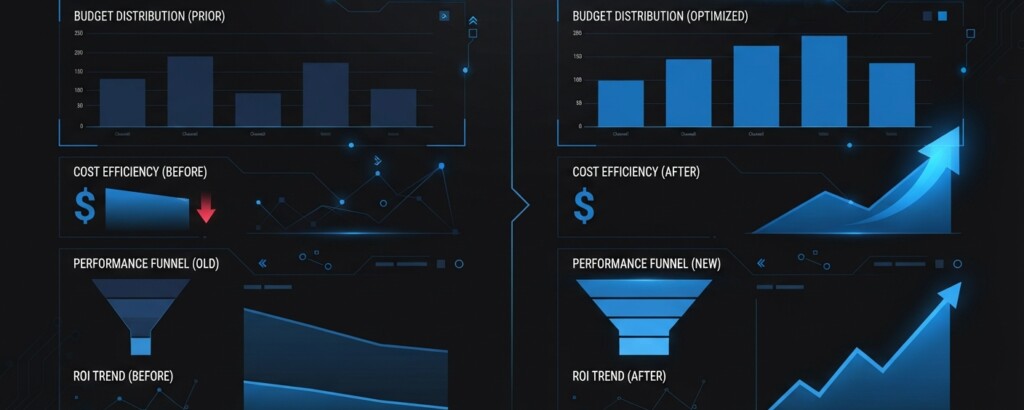
Consider a mid-sized ecommerce brand spending $10,000 per month across Google Ads. Before any optimization, budget was split evenly: about $3,300 each to branded search, generic category search, and a broad prospecting campaign. Branded search was converting at a $12 cost per acquisition, generic search at $45, and prospecting at $110 — but prospecting was still getting equal funding. Using the funnel-based model, the team reallocated as follows: branded and high-intent product search (conversion stage) received 45% of budget, category and comparison terms (consideration stage) received 33%, and prospecting (awareness stage) was trimmed to 22% with a hard daily cap.
| Conversion stage budget (45%) | $4,500 |
| Consideration stage budget (33%) | $3,300 |
| Awareness stage budget (22%) | $2,200 |
| Total monthly budget | $10,000 |
After six weeks, blended cost per acquisition dropped from $26 to $21, and overall conversion volume increased by nearly 23%, even though total spend stayed flat. The gain came entirely from shifting dollars toward what was already working and putting a ceiling on the speculative spend that wasn’t.
Monitoring and Adjusting Without Overreacting
Budget allocation isn’t a set-it-and-forget-it exercise, but it also shouldn’t be adjusted daily. Paid search data is noisy in the short term — a campaign can look bad for three days and then swing back. Review budget performance on a weekly cadence for tactical adjustments and a monthly cadence for structural changes to the allocation model itself.
- Check pacing weekly to make sure campaigns aren’t running out of budget early in the day, which caps how much data you collect.
- Review cost per acquisition and ROAS by campaign monthly, not daily, to avoid reacting to normal fluctuation.
- Reallocate in small increments — moving 5-10% of budget between campaigns at a time preserves algorithm stability.
- Keep a testing budget separate from your core allocation so new ideas don’t compete with proven performers for funding.
Set a fixed testing budget — commonly 10-15% of total spend — that’s protected from reallocation pressure. This is how you keep innovating without starving the campaigns that already work.
One more thing worth watching: seasonality and business cycles. A budget allocation model built in a slow month won’t necessarily hold during a peak season when competition and cost per click rise across the board. Revisit your allocation ahead of known seasonal shifts rather than reacting after performance has already dropped.
Key Takeaways
Smart PPC budget allocation and bid strategy comes down to a few core principles: fund what’s proven, protect a small budget for experimentation, and match your bidding approach to how much data each campaign actually has. Structure your account around funnel stages so conversion-ready campaigns never go underfunded while speculative tests are capped and controlled. Give automated bidding strategies enough data before switching, and change one variable at a time so you can actually learn what worked. The accounts that consistently improve aren’t the ones with the cleverest ad copy — they’re the ones where budget and bid strategy are reviewed on a disciplined schedule and adjusted with intention rather than instinct.
Want more hands-on PPC guidance?
Explore our other practical playbooks on paid advertising, analytics, and marketing strategy to keep sharpening how you plan, spend, and measure results.