
Sit in on a paid media strategy meeting and you will hear a steady stream of acronyms — CPC, CTR, ROAS, QS, CPM — tossed around like everyone was born knowing them. They were not. Paid advertising terminology is learned, not inherited, and once you have a solid grasp of it, campaign conversations stop feeling like a foreign language and start feeling like a normal part of your job. This glossary-style guide breaks down the essential PPC and paid media terms you need to participate confidently in budget reviews, platform setup, and performance reporting — no prior ad-buying experience required.
Whether you are a digital marketer new to paid channels, a marketing manager who approves budgets but does not run campaigns personally, or a small business owner trying to understand what your agency is actually doing with your money, this article will give you a practical working vocabulary. By the end, you will understand the core metrics, bidding concepts, targeting terms, and strategic frameworks that show up in nearly every paid advertising discussion.
The Core Metrics Everyone Assumes You Know
Paid advertising is measured obsessively, and most of that measurement boils down to a handful of metrics that get referenced constantly. Understanding these first will make everything else click faster.
| Term | What It Means | Why It Matters |
|---|---|---|
| CPC (Cost Per Click) | The amount you pay each time someone clicks your ad | Core efficiency metric for traffic-driving campaigns |
| CPM (Cost Per Mille) | Cost per one thousand ad impressions | Used for brand awareness campaigns where clicks are not the goal |
| CTR (Click-Through Rate) | Percentage of people who click your ad after seeing it | Signals how relevant or compelling your ad is to the audience |
| CPA (Cost Per Acquisition) | Cost to generate one conversion, such as a sale or lead | Connects ad spend directly to business outcomes |
| ROAS (Return on Ad Spend) | Revenue generated for every dollar spent on ads | The headline number most stakeholders care about most |
| Conversion Rate | Percentage of clicks that result in a desired action | Shows how well your landing page and offer perform after the click |
Notice the pattern: cost metrics (CPC, CPM, CPA) tell you what you are paying, while performance metrics (CTR, conversion rate, ROAS) tell you what you are getting. A campaign can have a low CPC and still be a poor investment if conversion rate is weak, so these numbers need to be read together, not in isolation.
When someone reports only ROAS without mentioning spend or volume, ask for both. A 10x ROAS on fifty dollars of spend is a nice anecdote, not a scalable strategy.

Bidding and Auction Terms: How the Money Actually Gets Spent
Paid advertising platforms like Google Ads and Meta Ads run on auction systems, and understanding the vocabulary around bidding helps you make sense of why costs fluctuate and why two advertisers targeting the same audience can pay very different prices.
- Bid: The maximum amount you are willing to pay for a click, impression, or conversion, depending on your bidding strategy.
- Quality Score (Google Ads): A rating from one to ten reflecting ad relevance, expected click-through rate, and landing page experience. Higher scores typically lower your costs.
- Ad Rank: The calculation that determines your ad position, combining your bid with auction-time quality factors (including expected CTR, ad relevance, and landing page experience), Ad Rank thresholds, the context of the search, and the expected impact of assets and formats.
- Smart Bidding: Automated, machine-learning-driven bidding strategies such as Target CPA or Target ROAS that adjust bids in real time.
- Impression Share: The percentage of available impressions your ads actually received, useful for understanding missed opportunity.
- Frequency Cap: A limit on how many times the same person sees your ad within a given time period, common on social and programmatic display platforms.
A practical example: two businesses bid on the same keyword. One has a polished, relevant landing page and tightly themed ad copy, earning a Quality Score of 8. The other has a generic landing page and loosely related ad copy, earning a Quality Score of 4. Even if the second business bids higher, the first business can win a better ad position at a lower actual cost per click. This is why paid search specialists obsess over relevance, not just budget size.
Do not assume a higher budget automatically fixes poor performance. If Quality Score or relevance is low, you may simply be paying more to reach the same mediocre results. Fix the ad and landing page experience before pouring in more spend.
Targeting and Audience Terms Across Paid Media Channels
Paid advertising terminology shifts slightly depending on the platform, but the underlying targeting concepts are consistent across search, social, and display advertising. Knowing these terms helps you understand how campaigns reach the right people.
| Term | Definition | Common Platform Use |
|---|---|---|
| Keyword Match Type | Settings like broad, phrase, and exact match that control how closely a search must match your keyword to trigger an ad | Google Ads, Microsoft Ads |
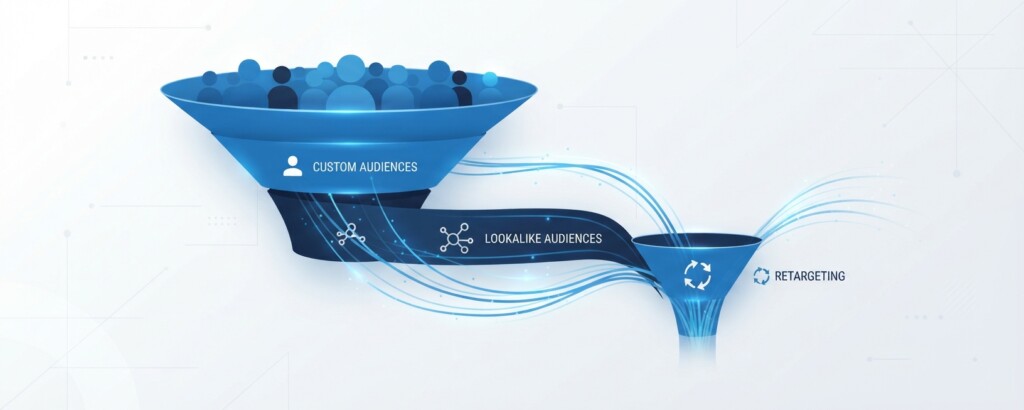
| Lookalike Audience | An audience modeled after your existing customers, built by the platform using behavioral similarities | Meta Ads, TikTok Ads |
| Retargeting (Remarketing) | Showing ads to people who already visited your website or engaged with your brand | Nearly all paid platforms |
| Custom Audience | An audience you build using your own data, such as an email list or website visitor list | Meta Ads, Google Ads (Customer Match) |
| Demographic Targeting | Narrowing audience reach by age, gender, income, or other demographic traits | Social and display platforms |
| Negative Keywords | Terms you exclude so your ads do not show for irrelevant searches | Google Ads, Microsoft Ads |
Consider a small business selling handmade furniture. They might build a custom audience from their email subscriber list, then ask the platform to generate a lookalike audience that shares similar traits with those subscribers. Meanwhile, their search campaign uses negative keywords like free and cheap to avoid attracting bargain hunters who are unlikely to convert. These targeting decisions, not just the ad creative, often determine whether a campaign succeeds.
Campaign Structure and Strategy Terms
Beyond metrics and targeting, there is a layer of structural vocabulary that describes how campaigns are organized and optimized over time. These terms come up constantly in planning meetings.
- Account: The top-level container holding all your campaigns on a given platform.
- Campaign: A group of ad sets or ad groups organized around a shared goal and budget.
- Ad Group (or Ad Set): A subdivision within a campaign that groups ads targeting a specific audience or keyword theme.
- A/B Testing (Split Testing): Running two versions of an ad or landing page simultaneously to see which performs better.
- Attribution Model: The rule set used to decide which touchpoint gets credit for a conversion, such as last-click or multi-touch attribution.
- Ad Fatigue: A decline in performance that happens when an audience sees the same ad too many times and starts ignoring it.
- Dayparting: Scheduling ads to run only during specific hours or days when performance is historically strongest.
Attribution deserves special attention because it quietly shapes how success gets measured. A last-click attribution model gives full credit to the final ad someone clicked before converting, which can undervalue the social media ad that first introduced them to the brand three weeks earlier. Many teams now lean toward multi-touch or data-driven attribution models to get a fuller picture of the customer journey, especially when running paid search and paid social simultaneously.
If your team reports results using different attribution models across channels, your numbers will not line up cleanly. Align on one attribution approach before comparing performance across paid search, paid social, and email.
Where AI Fits Into Paid Advertising Terminology
Modern paid advertising platforms increasingly rely on AI and machine learning, which has introduced a newer set of terms practitioners need to understand. Performance Max, a Google Ads campaign type, uses AI to automatically distribute budget across Google’s inventory — including Search, Display, YouTube, Discover, Maps, and Gmail — based on predicted performance. Advantage+ campaigns on Meta similarly use machine learning to automate audience targeting and placement decisions with minimal manual input.
These automated campaign types shift the marketer’s role from manual lever-pulling toward feeding the system good inputs — quality creative, accurate conversion data, and clear goals — and then monitoring outputs rather than micromanaging bids. Understanding terms like automated bidding, predictive audiences, and creative optimization will matter more each year as platforms continue to automate the mechanical parts of campaign management.
Key Takeaways
- Cost metrics like CPC and CPM tell you what you are paying; performance metrics like CTR and ROAS tell you what you are getting — read them together.
- Quality Score and Ad Rank explain why relevance often beats raw budget size in paid search auctions.
- Targeting terms like lookalike audiences, custom audiences, and retargeting describe how platforms find and re-engage the right people.
- Attribution models determine which channel gets credit for a conversion, so align on one model before comparing results.
- AI-driven campaign types like Performance Max and Advantage+ are shifting paid advertising terminology toward automation and predictive targeting.
Paid advertising terminology is not a barrier meant to keep outsiders out — it is a shared shorthand that makes fast-moving campaign conversations more efficient once you know the vocabulary. You do not need to memorize every term overnight. Keep this glossary nearby, refer back to it during your next campaign review, and the language will start to feel natural within a few conversations.
Ready to turn vocabulary into strategy?
Understanding the terms is the first step. If you want help translating these concepts into a paid media plan that actually drives results, explore our related guides on campaign strategy, budgeting frameworks, and performance reporting.