
Walk into any marketing meeting and you will hear phrases like ‘we need to improve our domain authority’ or ‘our crawl budget is a mess’ tossed around like everyone understands them. Most people nod along. This SEO terminology glossary exists so you never have to be that person again. Whether you are a marketing manager reviewing an agency report or a small business owner trying to make sense of a plugin dashboard, understanding core SEO terms is the fastest way to start making confident decisions instead of guessing.
By the end of this article, you will know the vocabulary behind technical SEO, on-page optimization, link building, and search performance measurement — and you will be able to use these terms correctly in conversations, reports, and strategy documents.
Foundational SEO Terms Everyone Should Know First
Before diving into technical details, it helps to lock in the basics. These are the terms you will encounter in almost every SEO conversation, tool, or article.
- Search Engine Optimization (SEO): the practice of improving a website so it ranks higher in organic, unpaid search results.
- Organic traffic: visitors who land on your site from unpaid search engine results, as opposed to paid ads.
- SERP (Search Engine Results Page): the page a search engine shows after someone types a query, including organic listings, ads, and features like maps or featured snippets.
- Keyword: a word or phrase people type into a search engine; the starting point for most SEO work.
- Ranking: a site’s position on the SERP for a given keyword, with position one being the top organic result.
Quick tip: when someone says ‘we rank number one,’ always ask ‘for which keyword, and in which location or device?’ Rankings vary by search term, country, and even whether someone is searching on a phone or desktop.
On-Page and Content SEO Terms
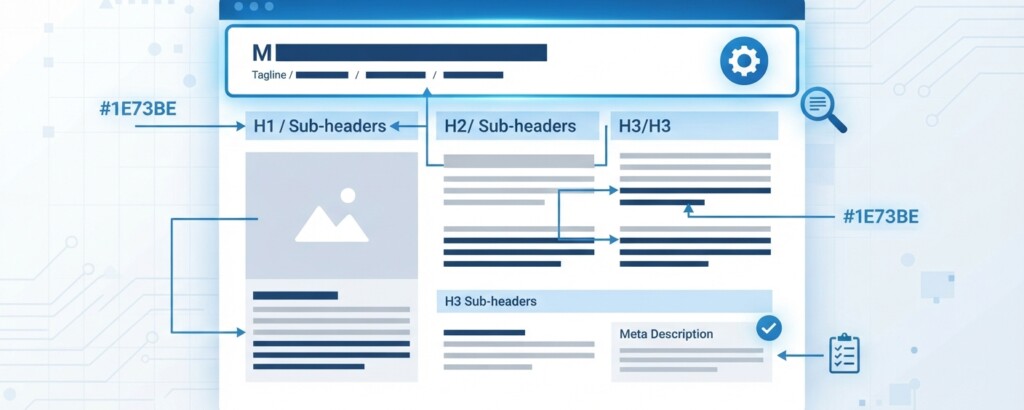
On-page SEO refers to everything you control directly on your website — the words, structure, and code that help search engines understand what a page is about.
| Term | What It Means | Why It Matters |
|---|---|---|
| Title tag | The clickable headline shown in search results, set in a page's HTML code. | Strong title tags improve click-through rate and signal relevance to search engines. |
| Meta description | A short summary shown under the title tag in search results. | It does not directly affect rankings but influences whether people click. |
| H1 / H2 tags | HTML heading tags that structure a page's content. | Clear headings help both readers and search engines understand page topics. |
| Alt text | A written description of an image, used by screen readers and search engines. | Improves accessibility and helps images appear in image search. |
| Keyword density | The frequency of a keyword relative to total word count on a page. | Overuse looks spammy; modern SEO favors natural, topic-rich writing instead. |
| Internal linking | Links from one page on your site to another page on the same site. | Helps search engines discover pages and distributes ranking value across your site. |
A practical example: imagine a bakery’s website has a blog post titled ‘Best Wedding Cake Flavors.’ A well-optimized version would include a descriptive title tag, a meta description that invites clicks, H2 subheadings for each flavor, and internal links to the bakery’s wedding cake ordering page. None of these elements alone guarantees a top ranking, but together they make the page easier for both Google and readers to understand.
Technical SEO and Site Structure Terms
Technical SEO is the behind-the-scenes work that makes sure search engines can find, crawl, and index your site properly. These terms show up often in audits and developer conversations.
- Crawling: the process by which search engine bots visit and scan pages on your site.
- Indexing: storing a crawled page in a search engine’s database so it can appear in results.
- Crawl budget: the number of pages a search engine will crawl on your site within a given time period, which matters most for very large sites.
- XML sitemap: a file listing all important pages on a site, submitted to help search engines find them faster.
- Robots.txt: a file that tells search engine bots which pages or sections they should or should not crawl.
- Canonical tag: a piece of code that tells search engines which version of a duplicate page is the ‘main’ one to index.
- Core Web Vitals: a set of Google metrics measuring page loading speed, interactivity, and visual stability.
- Mobile-first indexing: Google’s practice of primarily using the mobile version of a site’s content for indexing and ranking.
Do not block important pages in your robots.txt file by mistake. A single misplaced line can accidentally block search engine crawlers from your entire site, and this is one of the most common — and costly — technical SEO errors small businesses make after a website redesign.
Off-Page SEO and Authority Terms
Off-page SEO covers actions taken outside your own website that influence how search engines and users perceive your credibility, primarily through links and reputation signals.
- Backlink: a link from another website pointing to yours; often considered a vote of confidence.
- Domain authority: a third-party score (not a Google metric) that estimates how likely a site is to rank, based largely on its backlink profile.
- Anchor text: the clickable text of a hyperlink, which gives context about the linked page’s topic.
- Nofollow link: a link with a tag telling search engines not to pass ranking credit to the destination page.
- Link building: the ongoing practice of earning or acquiring backlinks to improve authority and rankings.
- E-E-A-T: Experience, Expertise, Authoritativeness, and Trustworthiness — Google’s framework for evaluating content quality, especially for topics affecting health, finance, or safety.
Consider a local law firm trying to rank for ‘family lawyer in Denver.’ A single backlink from a well-respected legal directory will likely do more for their rankings than fifty low-quality links from unrelated spam sites. This is why SEO practitioners emphasize link quality over link quantity.

Measurement and Strategy Terms in SEO
Understanding SEO terminology also means knowing how professionals measure success and plan future work. These terms appear constantly in reports and strategy decks.
| Organic sessions this month | 12,400 |
| Organic sessions last month | 10,800 |
| Month-over-month growth | +14.8% |
That simple comparison above is how most SEO reports communicate progress: current organic traffic versus a previous period, expressed as a percentage change. Beyond traffic, marketers also track these core terms.
- Click-through rate (CTR): the percentage of people who click your listing after seeing it in search results.
- Bounce rate: the percentage of visitors who leave after viewing only one page, though modern analytics tools increasingly favor engagement-based metrics instead.
- Conversion rate: the percentage of visitors who complete a desired action, such as filling out a form or making a purchase.
- Keyword difficulty: a score estimating how hard it would be to rank for a given keyword, based on competition.
- Search intent: the underlying reason behind a search query — informational, navigational, transactional, or commercial investigation.
- SEO audit: a comprehensive review of a website’s technical, on-page, and off-page SEO health, usually producing a prioritized action list.
When reviewing SEO reports, always ask what business outcome a metric is tied to. Rising organic traffic is encouraging, but rising conversions from organic traffic is what actually matters to the business.
Key Takeaways
SEO terminology is not meant to be intimidating — it is simply a shared vocabulary that makes collaboration faster between marketers, developers, and business stakeholders. Here is what to remember from this SEO glossary.
- On-page terms like title tags, meta descriptions, and internal links describe elements you control directly on your site.
- Technical SEO terms like crawling, indexing, and robots.txt govern whether search engines can access your content at all.
- Off-page terms like backlinks and domain authority describe how the wider web vouches for your credibility.
- Measurement terms like CTR, conversion rate, and search intent help you judge whether SEO work is actually driving business results.
- Knowing this terminology lets you ask sharper questions, evaluate agency or freelancer work more confidently, and make better strategic decisions.
Mastering SEO terminology is the first real step toward mastering SEO itself. Once the vocabulary clicks, audits stop feeling like foreign documents, reports start telling a clear story, and conversations with developers or agencies become genuinely productive.
Ready to put this SEO vocabulary into practice?
Explore more practical guides on SEO, content strategy, and digital marketing fundamentals to keep building skills you can apply immediately.