
If you run a business that serves customers in a specific city or neighborhood, ranking in the Map Pack — those three highlighted local results with a map that appear above organic search results — matters more than almost any other SEO win you can chase. This is the heart of local SEO mastery: getting your Google Business Profile in front of nearby customers at the exact moment they are searching for what you offer. This article walks through exactly how to set up, optimize, and maintain your profile so it competes for those top three spots, plus how to think about ranking factors like a search engine does.
What the Map Pack Actually Rewards
Before touching your profile settings, it helps to understand what Google is scoring. Local ranking comes down to three factors: relevance, distance, and prominence. Relevance means how well your business profile matches what someone typed into the search bar. Distance is how close your business is to the searcher (or the location they searched for). Prominence is a mix of your reviews, your online mentions, your website authority, and how well-known your business is offline and online.
You cannot control distance — a competitor whose storefront is next to the searcher will usually beat you if you are three miles away. But relevance and prominence are almost entirely within your control, and that is where most of your optimization energy should go. A common mistake is treating Google Business Profile as a one-time listing you fill out and forget. In reality, it behaves more like a living page that Google re-evaluates continuously based on fresh signals: new photos, new reviews, updated posts, and consistent information across the web.
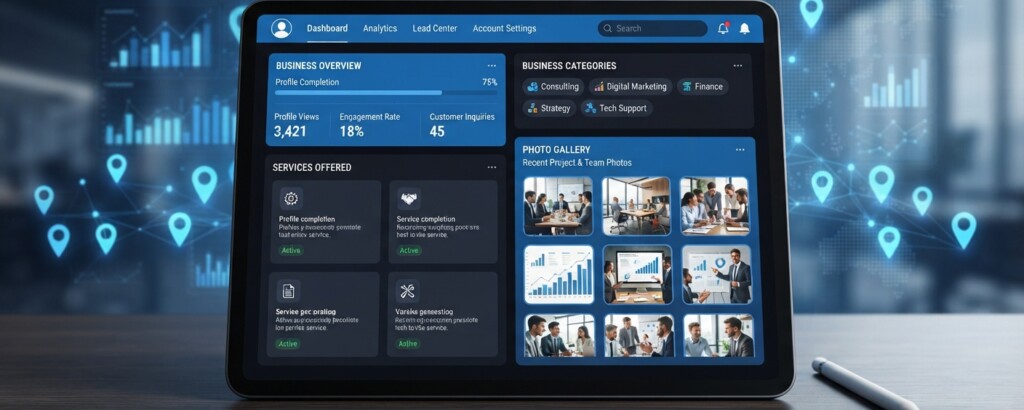
Think of your Google Business Profile as a mini-website that lives inside Google Search and Maps. The fields you fill out — categories, services, attributes, hours — shape your visibility and customer actions, not just as a courtesy to customers.
Building a Complete and Accurate Profile
Start with the basics, because incomplete profiles rarely rank well no matter how good your reviews are. Your business name should match your real-world signage exactly — do not stuff keywords into the name field, since Google actively penalizes this. Choose your primary category carefully; this single field carries enormous weight in determining which searches you show up for. A pizza restaurant listed under ‘Restaurant’ instead of ‘Pizza Restaurant’ is leaving visibility on the table.
After the primary category, add secondary categories that reflect everything you genuinely offer, but avoid adding categories that do not apply just to appear in more searches — this can hurt relevance signals over time. Fill in your service area if you travel to customers, or your exact address if customers visit you. Add your phone number, website URL, and hours, including special hours for holidays. Incomplete profiles signal low effort to Google’s algorithm, and low effort correlates with lower rankings.
- Claim and verify your profile through postcard, phone, or video verification depending on what Google offers your business type.
- Select one precise primary category and up to nine relevant secondary categories.
- Write a business description using natural language that includes your services and location without keyword stuffing.
- Add your products or services with descriptions, pricing where possible, and clear names.
- Upload at least ten high-quality photos covering your storefront, team, products, and interior.
- Monitor the Q&A section and customer inquiries so you can respond quickly to prospective customers.
Reviews, Reputation, and the Prominence Factor
Reviews are the single most visible prominence signal to both Google and human searchers. A profile with 150 reviews averaging 4.6 stars will almost always outrank a nearly identical competitor with 12 reviews averaging 4.8 stars, because volume and recency matter alongside average rating. Google wants evidence that real customers are actively engaging with your business, not just that you have a few glowing testimonials from years ago.
Build a simple, repeatable system for requesting reviews. Send a text or email shortly after a purchase or service is completed, when the experience is still fresh. Make the ask specific — asking customers to mention the service they received or the location they visited actually helps your relevance signals, since Google can read review text for keyword context. Respond to every review, positive and negative. A thoughtful reply to a critical review often does more for your reputation than a dozen five-star reviews with no responses, because it shows prospective customers you take feedback seriously.
| Review Signal | Why It Matters | Practical Action |
|---|---|---|
| Review volume | Signals ongoing customer engagement and business activity | Ask every satisfied customer for a review within 48 hours |
| Review recency | Fresh reviews weigh more heavily than old ones | Build review requests into your regular customer workflow |
| Review response rate | Shows active management and customer care | Reply to all reviews within a few days, especially negative ones |
| Keyword mentions in reviews | Reinforces relevance for specific services or locations | Ask customers what service they used, without scripting exact phrases |
Never offer discounts, cash, or incentives in exchange for reviews, and never write or post fake reviews yourself. Google actively detects review manipulation patterns, and violations can result in your profile being suspended or permanently removed from Maps.
Posts, Photos, and Ongoing Activity Signals
Google Business Profile includes a posting feature similar to a social media feed, and most businesses ignore it entirely — which is exactly why using it consistently gives you an edge. Posts can announce promotions, new products, events, or simply share updates about your business. While they are not a direct ranking factor, they appear directly on your profile, can trigger search justifications, and drive customer engagement. Aim for at least one post per week, and use natural language that reflects real searches customers might type.
Photos deserve just as much attention. Profiles with more photos receive significantly more requests for directions and website clicks than profiles with few or no images, according to data Google itself has shared with business owners. Upload new photos regularly rather than dumping twenty images once and never returning. Avoid wasting time geotagging images since Google strips EXIF metadata upon upload; instead, make sure photos accurately represent your current location, staff, and offerings — outdated photos create a mismatch between what customers expect and what they find.

A Simple Local SEO Maintenance Framework
Local SEO mastery is not a single project you complete and move past — it is a maintenance habit, similar to keeping your storefront clean or your inventory stocked. A practical framework is to divide your efforts into daily, weekly, and monthly tasks so nothing falls through the cracks. Daily tasks include monitoring and responding to new reviews and customer questions. Weekly tasks include publishing at least one post and checking for new photos to upload. Monthly tasks include auditing your NAP consistency (name, address, phone number) across directories like Yelp, Facebook, and industry-specific sites, since mismatched information across the web undermines the prominence signals Google relies on.
Also build in a quarterly competitive check. Search your main keywords from a customer’s perspective, note who appears in the Map Pack, and study what they are doing differently — their category selection, review count, photo volume, or posting frequency. This is not about copying competitors but about identifying gaps in your own strategy that are easy to overlook when you are focused only on your own listing.
| Frequency | Task | Purpose |
|---|---|---|
| Daily | Respond to reviews and customer inquiries | Maintain fast response signals and customer trust |
| Weekly | Publish one Business Profile post | Keep profile active and trigger search justifications |
| Weekly | Add one to two new photos | Sustain visual engagement signals |
| Monthly | Audit NAP consistency across directories | Reinforce prominence and trust signals |
| Quarterly | Review competitor Map Pack listings | Spot gaps and opportunities in your own strategy |
Set a recurring calendar reminder for your local SEO tasks. Businesses that treat Google Business Profile maintenance like a scheduled habit consistently outperform those that only touch it when rankings drop.
Key Takeaways
Winning the Map Pack comes down to consistently reinforcing relevance and prominence since distance is largely out of your hands. Complete every field in your Google Business Profile accurately, choose categories with precision, build a steady stream of genuine reviews and respond to all of them, post regularly, and keep your photo gallery current. None of these steps require paid tools or technical expertise — they require consistency. Local SEO mastery is achievable for any small business willing to treat their Google Business Profile as an active marketing channel rather than a static listing.
Ready to Strengthen Your Local Search Presence?
Explore more practical guides on SEO, content marketing, and analytics to build a complete digital marketing skill set that drives real results for your business.